Le champ des possibles
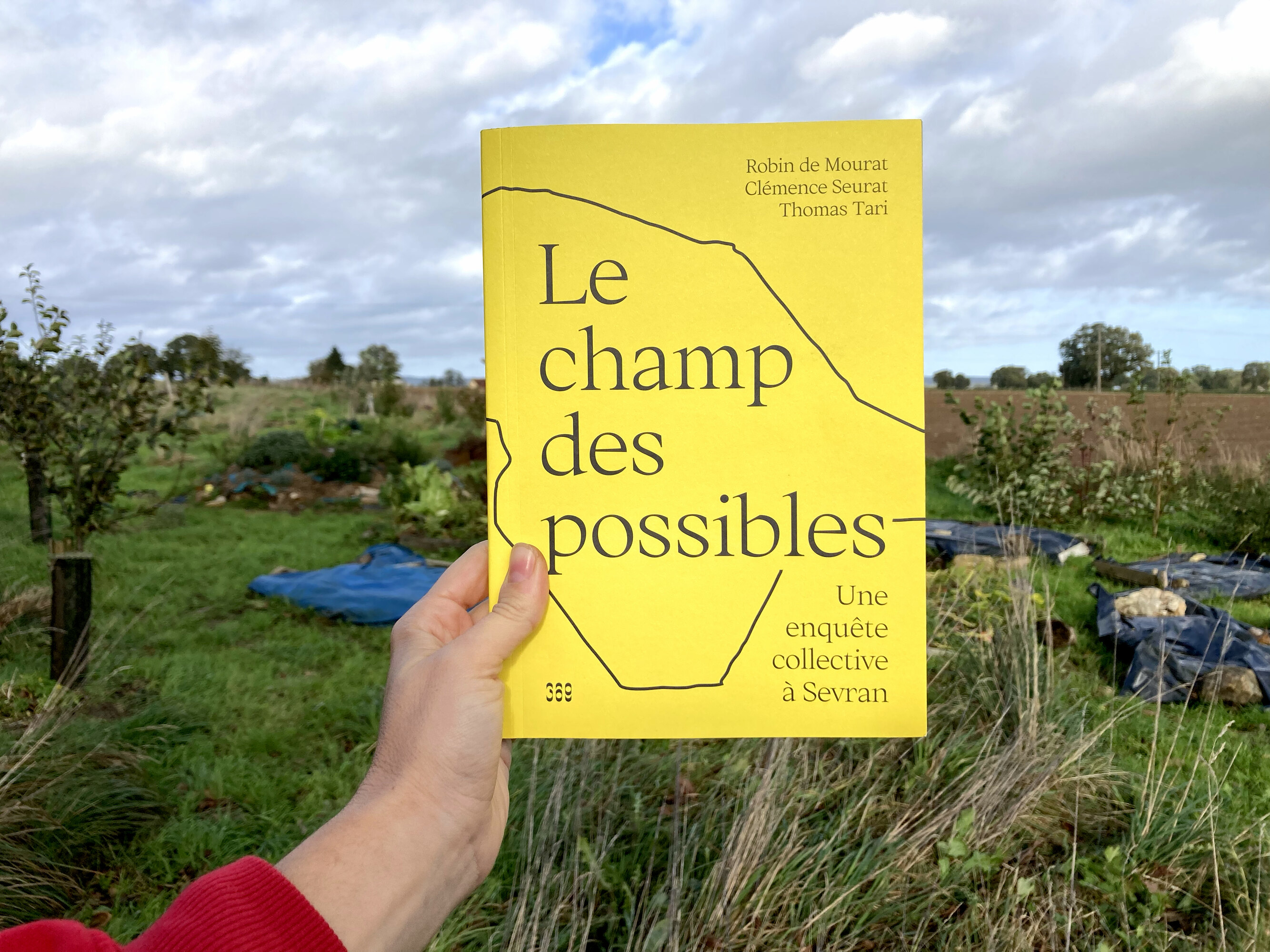
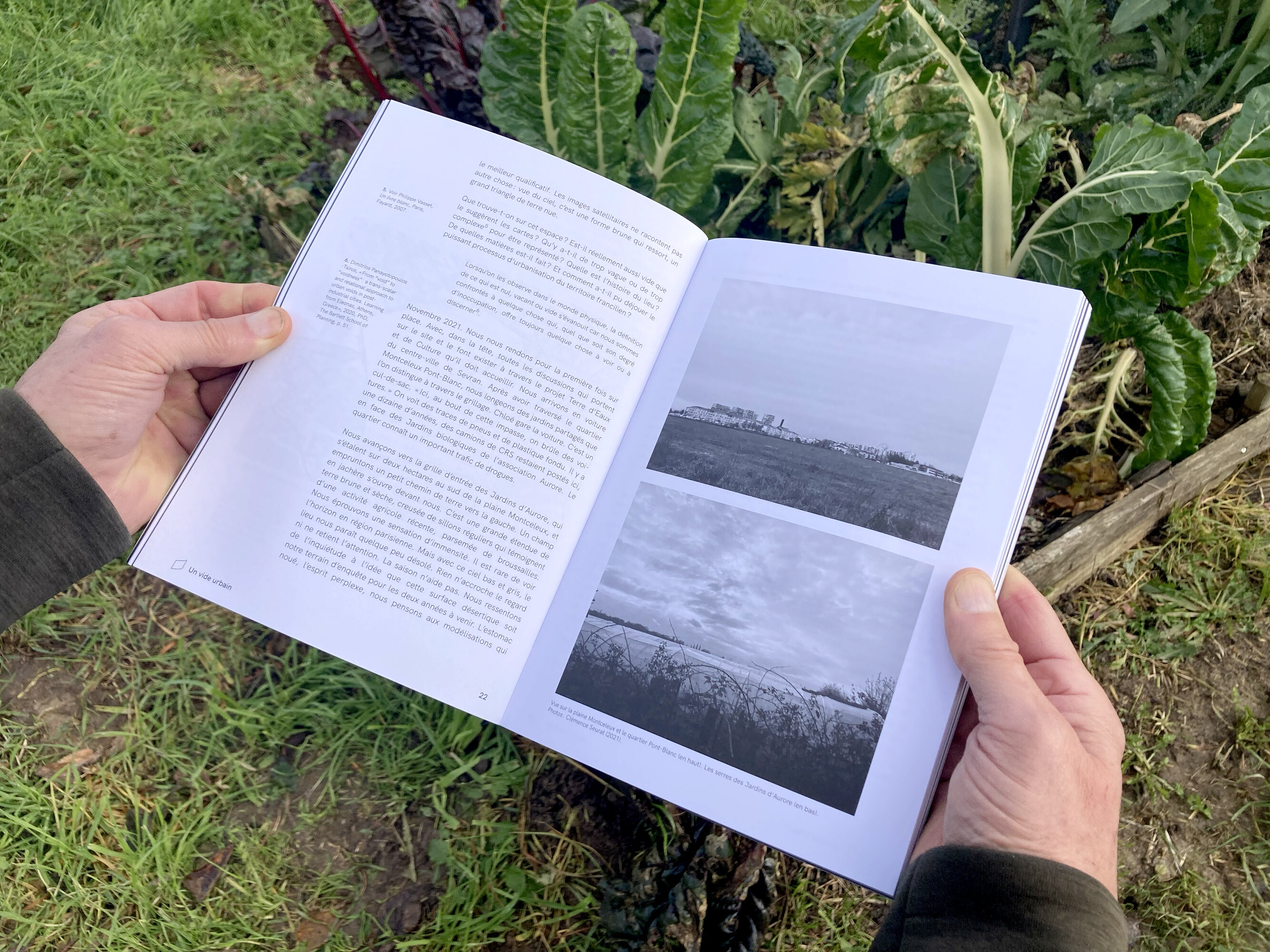
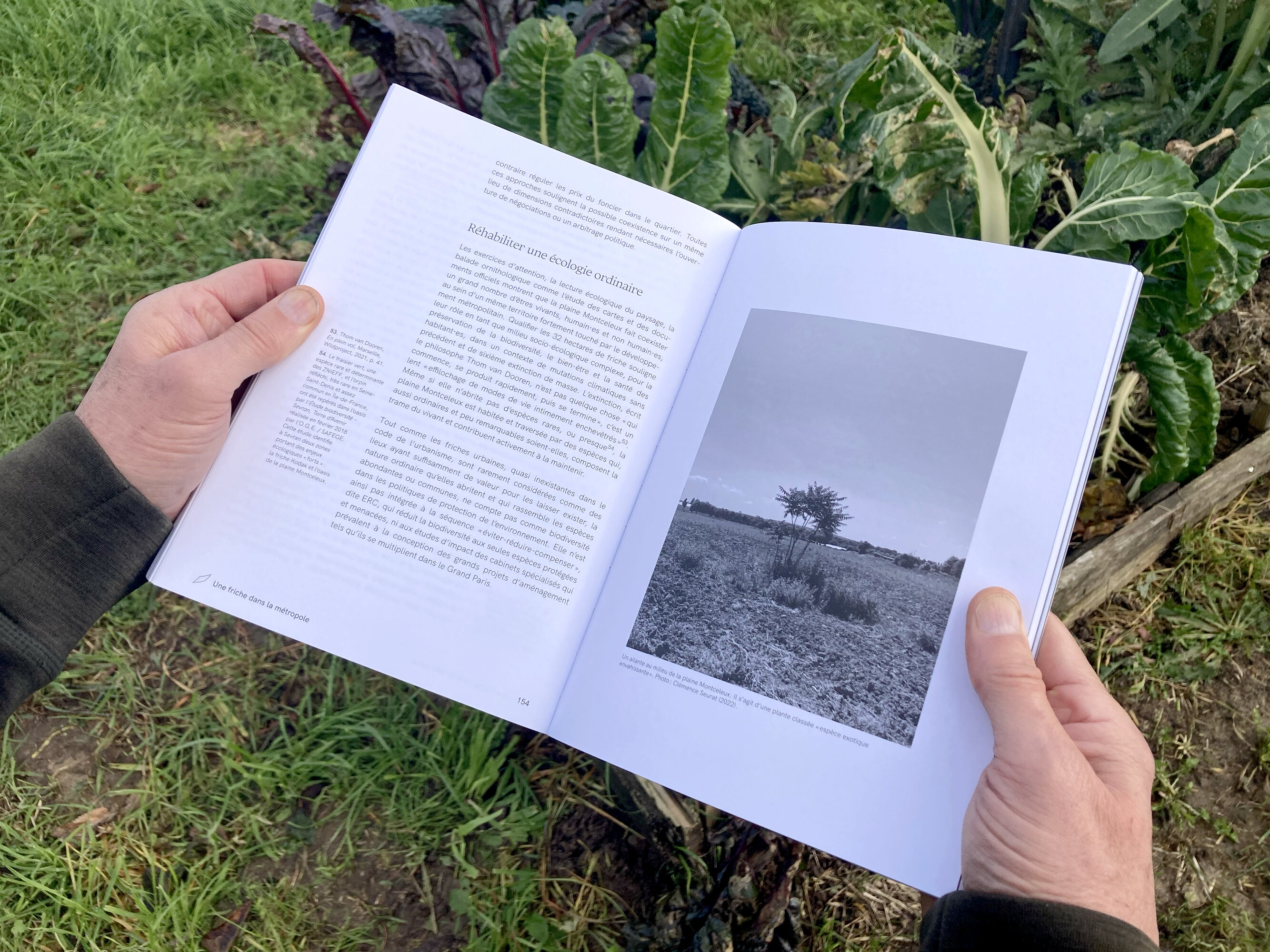
The Field of Possibilities: A Collective Investigation in Sevran is a print and online publication. It offers an ethnography of a 32-hectare area in Sevran, Seine-Saint-Denis. Studied from multiple disciplines and practices, this seemingly unremarkable place is presented in turn as an urban void, a land of projects, an area to be planned, a suburban field, a wasteland in the metropolis, a common space to be inhabited. 1
This publication is the result of a field study conducted by authors Robin de Mourat, Clémence Seurat, and Thomas Tari with local residents. The project was supported by Sciences Po’s Médialab, La Pourdrerie - Théâtre des Habitants, and the Daniel & Nina Carasso Foundation.
The object of interest was a developing area coveted by developers such as Linkcity, which proposed a surfing complex. “An ecological aberration and symbol of gentrification and social exclusion, the facility was controversial from the outset and was ultimately abandoned.” The area was caught up in the phenomenon of the metropolitanization of Greater Paris. “French cities are often built according to a logic that is far removed from the concerns of their inhabitants. Highlighting a lack of transparency and democracy, the opinion of the population led to the abandonment of the project” 2
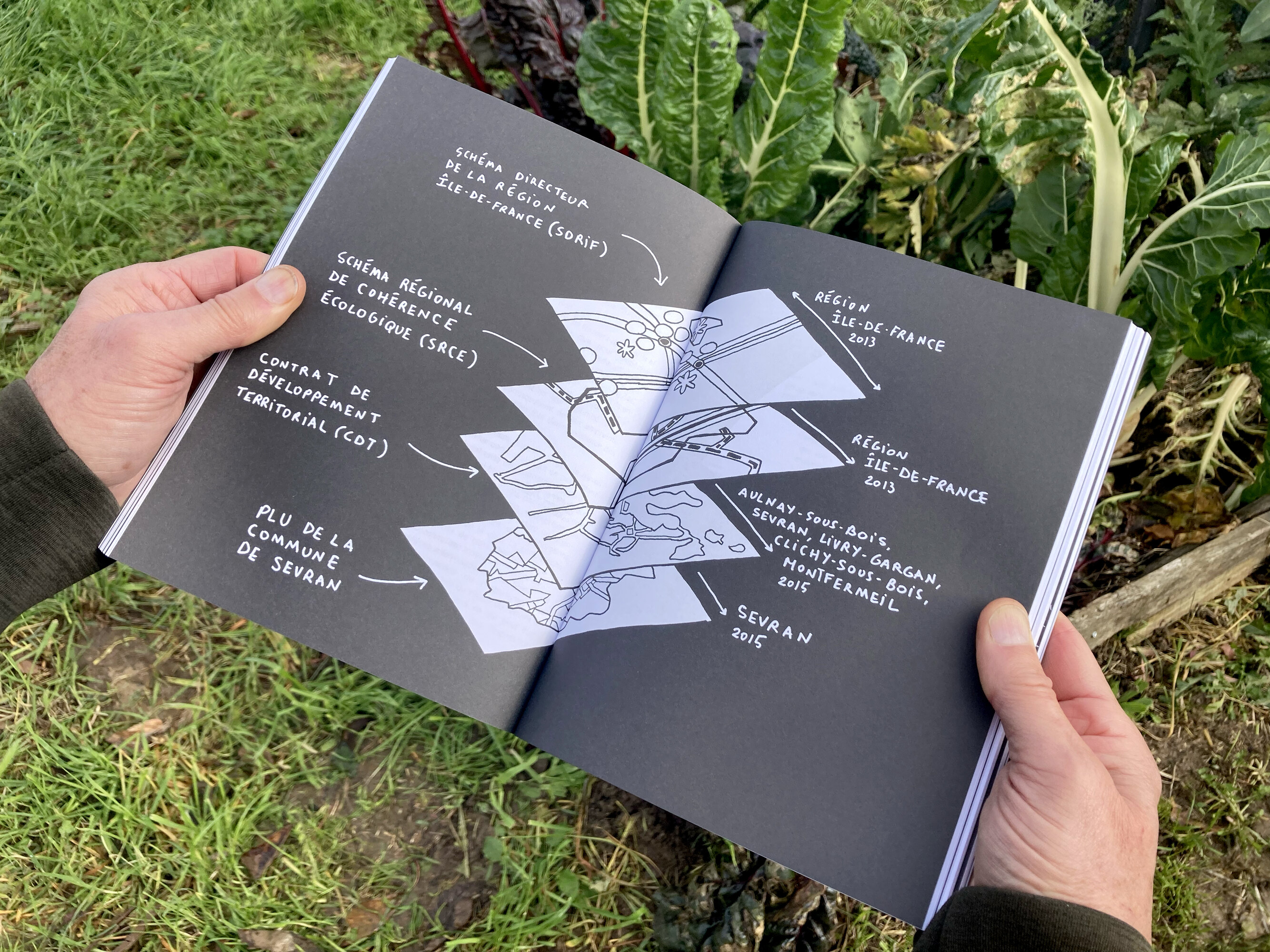
Over two years of research and discussions, this territory was mapped out, revealing different ways of seeing it. As part of this work, a participatory research protocol was established, combining methods from the social sciences, the arts, and tacit knowledge.
Workshops were organized, allowing participants to explore and practice their living environment.
Through the discussions it raises, this book opens up the field of possible perspectives on a territory. The prism through which we observe it influences our perception: is it an “urban void,” a filled space, or a biological reserve, a space to be preserved? All these perspectives open up a variety of possibilities. However, listening to the sound creation Contrevoix, we note that most residents generally tend toward a space where nature would have a place of choice.
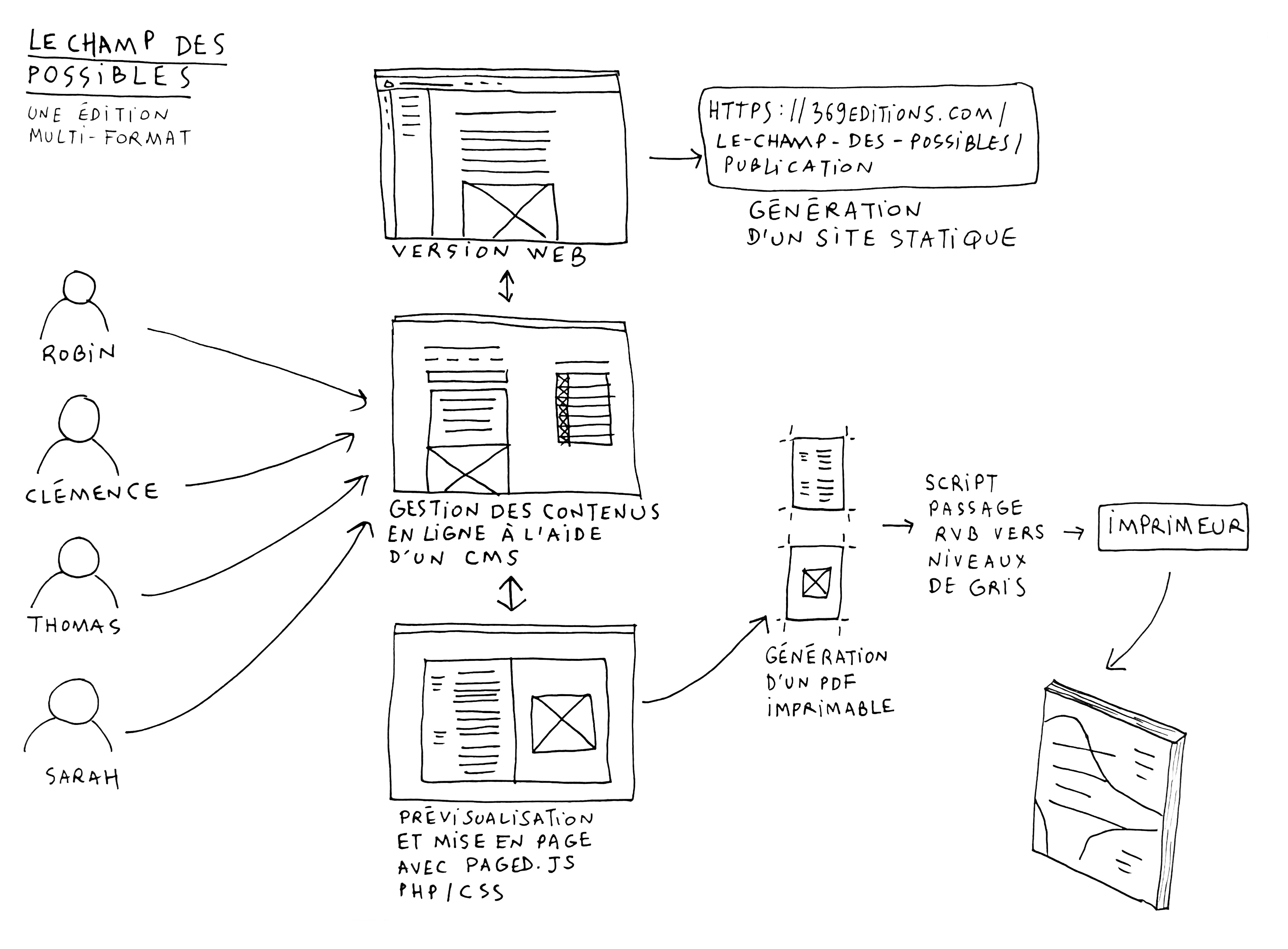
The editorial model for this publication involved a collaborative process of content development and collection, requiring the creation of an online editorial platform. The graphic design was created in web-to-print using Paged.JS.
- https://369editions.com/le-champ-des-possibles/publication/ ↩
- À Sevran, un champ des possibles, Terrestres, 2024 https://www.terrestres.org/2024/03/09/a-sevran-un-champ-de-possibles/ ↩
Toolchain
Texts and images from various sources > Kirby CMS (with specifically developed plugins) > CSS and Paged.js > PDF (Ghostscript script to prepare the PDF for printing) and web page (Static site from Kirby)
Infos
Type
Book
Author(s)
Robin de Mourat, Clémence Seurat, Thomas Tari
Designer(s)
Sarah Garcin
Publisher
369 éditions
Printing
Offset Black and white
Pages
208
Papers
Arena White Rough 3 00g/m², Amber Graphi cs 100 g/m²
Binding
Perfect binding
Size
170 × 240mm
Technologies
Kirby, HTML, CSS, Javascript, Paged.js
Year
2023
Copies
200
Language
French
Printer
Tallinna Raamatutrük i koja OÜ
Authors (Robin de Mourat, Clémence Seurat, Thomas Tari) and collective of Sevran residents
Designer (Sarah Garcin)
Designer (Sarah Garcin)
Designer (Sarah Garcin)
Tallinna Raamatutrükikoja OÜ
Google Docs / Drive
Paper, Pens and Gimp (Illustrations)
Kirby CMS
Paged.js
HTML / PHP / CSS / JS
Chromium
Ghostscript
Printer Pre-press software
Offset Printer
Série d’ateliers sur la friche: Enquête, Photographies, Écriture
Écriture des textes, Sélection d'images
Réalisation des Illustrations
Adding materials into Kirby CMS
Front-end development of the edition's visualisation
Graphic design and layout of the edition
Export PDF in RGB
Conversion of RGB PDF to prepress PDF with black and white colour profile
Printing of the black and white offset edition
Google Drive organised by chapters containing Google Docs, formatted texts
Images classified by chapters
Series of illustrations in jpg format
Collaborative, online interface for content integration
Visualisation of the edition and its layout
Live preview of the layout
Print and web version
Ready to print PDF
Printed book
How to stop using Google services ?
Footnotes issue. In this project, to insert a footnote, it had to be inserted like this (note: this is a footnote), which is quite time-consuming to do during data integration.
What automation processes are possible between content created with word processing software and content formatted for the web?
=> See CMS such as Lodel developed by OpenEdition.
Collecting data
Authors (Robin de Mourat, Clémence Seurat, Thomas Tari) and collective of Sevran residents
Google Docs / Drive
Paper, Pens and Gimp (Illustrations)
Série d’ateliers sur la friche: Enquête, Photographies, Écriture
Écriture des textes, Sélection d'images
Réalisation des Illustrations
Google Drive organised by chapters containing Google Docs, formatted texts
Images classified by chapters
Series of illustrations in jpg format
How to stop using Google services ?
Transforming data
Designer (Sarah Garcin)
Kirby CMS
Adding materials into Kirby CMS
Collaborative, online interface for content integration
Visualisation of the edition and its layout
Footnotes issue. In this project, to insert a footnote, it had to be inserted like this (note: this is a footnote), which is quite time-consuming to do during data integration.
What automation processes are possible between content created with word processing software and content formatted for the web?
=> See CMS such as Lodel developed by OpenEdition.
Layout
Designer (Sarah Garcin)
Paged.js
HTML / PHP / CSS / JS
Front-end development of the edition's visualisation
Graphic design and layout of the edition
Live preview of the layout
Print and web version
Exporting
Designer (Sarah Garcin)
Chromium
Ghostscript
Export PDF in RGB
Conversion of RGB PDF to prepress PDF with black and white colour profile
Ready to print PDF
Printing
Tallinna Raamatutrükikoja OÜ
Printer Pre-press software
Offset Printer
Printing of the black and white offset edition
Printed book