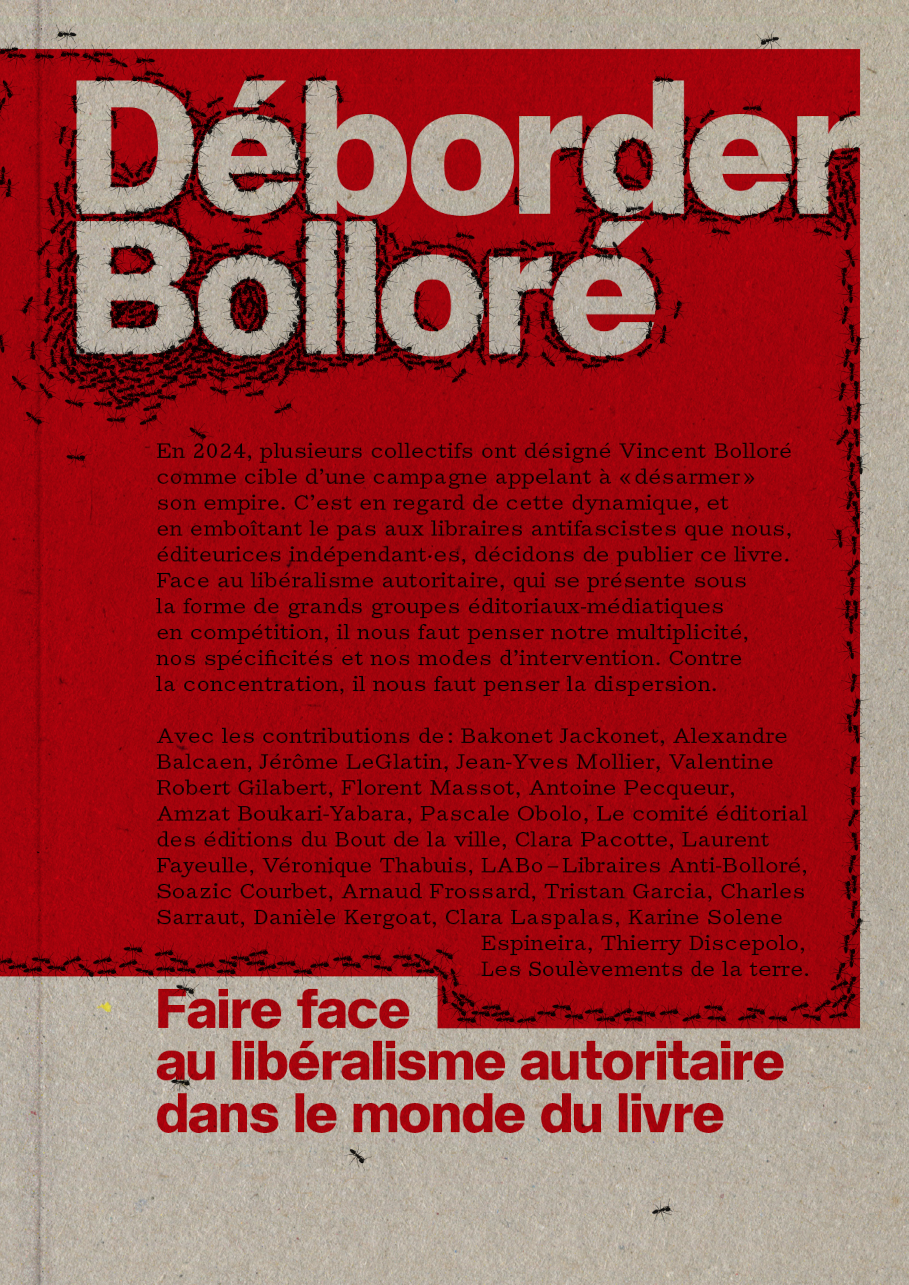
Déborder Bolloré
A multi-format publication co-edited by more than a hundred independent publishers, available for sale in bookstores and freely distributed on deborderbollore.fr in web, EPUB, and PDF formats. […]
The contributions highlight the thinking of researchers, printers, publishers, and booksellers who analyze and/or experience the dynamics of market concentration and extreme right-wing tendencies. Each contributor attempts to formulate, from their respective positions, answers to this urgent question: how can we confront authoritarian liberalism in the world of books?1
This publication is a large-scale collaborative initiative and the result of reflection by the independent publishing sector on the Bolloré empire, following the Désarmons Bolloré campaign and the call for a boycott by “anti-fascist booksellers.”
It should be noted that the collective behind this publication calls for critical thinking rather than a complete boycott of V. Bolloré. Indeed, booksellers are in a sensitive position, as the viability of their business still depends, despite everything, on figures from publications produced by large groups.
The authors of this publication use Vincent Bolloré as a figurehead to open up dialogue on the concentration of publishing power that has been in place since the early 19th century. This concentration has enabled large groups to represent 90% of the publishing market. This project goes beyond the figure of V. Bolloré and questions the dynamics of the publishing world.
The idea is to understand how the system works and then to thwart it. To leverage the diversity of independent publishing and counterbalance the monopoly embodied by V. Bolloré. In this way, the stakes are both economic and political. Independent publishers, these factories of counter-narratives, enable minority voices to be heard.
They are not fooled by the illusion of pluralism that can be seen in large groups. For example, the Fayard publishing house, which belongs to the Hachette group, publishes books by authors with similar values to those behind the publication Déborder Bolloré. However, the appointment of Lise Boell, Eric Zemmour’s publisher, as its head, as well as the publication of voices such as that of Jordan Bardella, serves an economic and political purpose, which, under the guise of coexistence, normalizes narratives of far-right power.
It had been fifteen years since a book by the National Rally had been seen in bookstores: the publishing world refused to produce works by a party founded by former Nazis and still promoting the fascistization of society. And now, it seems almost normal.2
In the interview with Médianes3, we see a desire to make content available online for free and adapted for screens. There is a desire to create a platform to bring together articles, texts from the collection, and also extensions to consolidate and shed light on certain gray areas. There is a desire to boost the sharing of knowledge and expertise around the struggles of the book sector in order to strengthen and promote collaboration among independents. Today, everyone operates within their own circle with their own dynamics. Although some meet at trade shows and/or collectives, networking in the broad sense remains difficult.
That is why this collective work was inspired by the La Pastèque initiative, a journal created by a group of independent publishers, with each company contributing according to its expertise.
The working method therefore involved pooling skills, thereby encouraging the involvement of a large number of participants who were able to work on an almost just-in-time basis. The aim of this methodology was to facilitate contacts in order to take ownership of the working infrastructure while promoting an open dynamic. In order to enhance accessibility for all participants, an InDesign file converter was created to convert files to flexible formats without having to redo corrections, thus enabling wider dissemination and distribution of the publication.
The organization was composed of several committees (publishing, communication, web development, press, etc.), each of which made its own decisions, and a large coordination team kept everyone informed of all developments.
This project therefore presents a model of collaboration where connections and a multiplicity of actors abound. It is a model where unity creates a possible and viable structure for independent actors in the publishing world.
In order to remain in line with their values regarding communication, free tools were chosen, such as Framasoft rather than Google Drive. However, Instagram remains a means of rapid visibility, so it was used along with more physical communication methods such as flyers and word of mouth, drawing on activist culture and fanzines.
This is where we see a need for links between publishers and independent media, because when we look at the Bolloré empire, we see that it owns publishing houses and media outlets that allow for more fluid promotion.
- https://deborderbollore.fr ↩
- « Ne laissons pas Bolloré et ses idées prendre le pouvoir sur nos librairies ! », Médiapart, 2024. https://blogs.mediapart.fr/les-invites-de-mediapart/blog/191124/ne-laissons-pas-bollore-et-ses-idees-prendre-le-pouvoir-sur-nos-librairies ↩
- Déborder Bolloré : une stratégie collective pour l’édition indépendante, Médianes, 2025 ↩
Toolchain
InDesign > IDML Pandoc Reader > Markdown > HTML/CSS/JS > web, PDF, EPUB
Infos
Type
Book
Author(s)
Collective work
Designer(s)
Adrien, Arnaud, Alaric, Arnaud, Benny, Camille, Clara, Coralie, Éléonore, Emmanuel, Jérôme, Johan, Julie, Léna, Merlin, Nicolas, Pascale, Quentin, Rodhlann, Théo, Yann et Zoé
Publisher
Collective co-publishing, co-published by 128 publishing houses
Printing
Offset : black and white, cover pantone + black
Technologies
InDesign, HTML, CSS, Javascript, Python, idml2xml-frontend
Year
2025
Language
French