Antoon Van Dyck
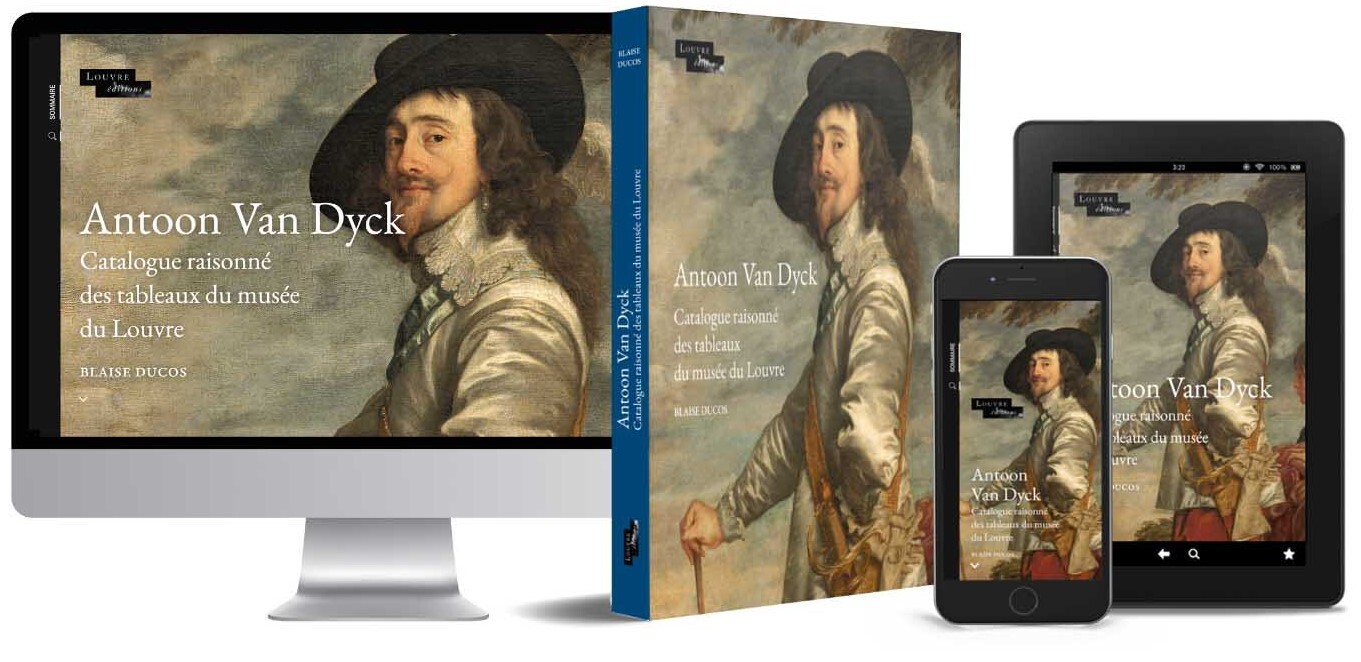
Antoon Van Dyck, Catalogue raisonné des tableaux du musée du Louvre (Antoon Van Dyck, Catalogue raisonné of paintings in the Louvre Museum) was published in 2023 by the Louvre Museum. It is the museum’s first multi-format book, which was released in four different formats: paper, online (website), digital book (Epub), and PDF. All digital formats are available free of charge.
By developing a book in digital formats adapted to the catalog of Antoon Van Dyck’s paintings, the Louvre Museum is making a commitment: it is affirming its desire to provide free, unlimited, and immediate access to the publications of the scientific research conducted within its walls, while taking on the challenge of dematerializing art books.1
The Louvre Museum has strived to produce a book that, in all its formats, is elegant and carefully edited, in order to offer Van Dyck’s paintings and Blaise Ducos’s texts all the quality and sensitivity associated with art books.
All of these formats guarantee ease of use, durability, and citability. The book is linked to the museum’s domain name, and links refer to the Louvre Collections website, allowing for clear identification and integration into the museum’s digital ecosystem.
The catalog is based on FRBR standards, which distinguish between the work, its expression, its manifestations, and its copies2, thus ensuring its proper referencing and presence in bookstore and library catalogs.
The project was entrusted to C&F éditions, with Nicolas Taffin overseeing the project and editorial supervision, Julien Taquet handling development, and Agathe Baez responsible for graphic design.
The project came about following a discussion between museum stakeholders and the interministerial digital department, which led them to the legal framework of the “innovative market” established in 2021, which allows for the notification of a market.
Work began in February 2022 and the book was published in May 2023. This timeframe includes the three to four months we had to devote to the legal procedures required to set up a separate call for tenders for print-on-demand, referencing, and distribution services. The total cost of digital development amounted to €47,000. This includes the development of the entire editorial chain, graphic design and layout, and integration of all content in all formats of the book: web, PDF, and EPUB.3
On the editorial side, the question of the OpenEdition platform arose. However, this platform is designed for scientific publications, making articles its standard format. Furthermore, in an art history book, images are objects of study in their own right and are not intended to be illustrative. The Louvre called on Julien Taquet and the Coko Foundation to develop a customized editorial chain.
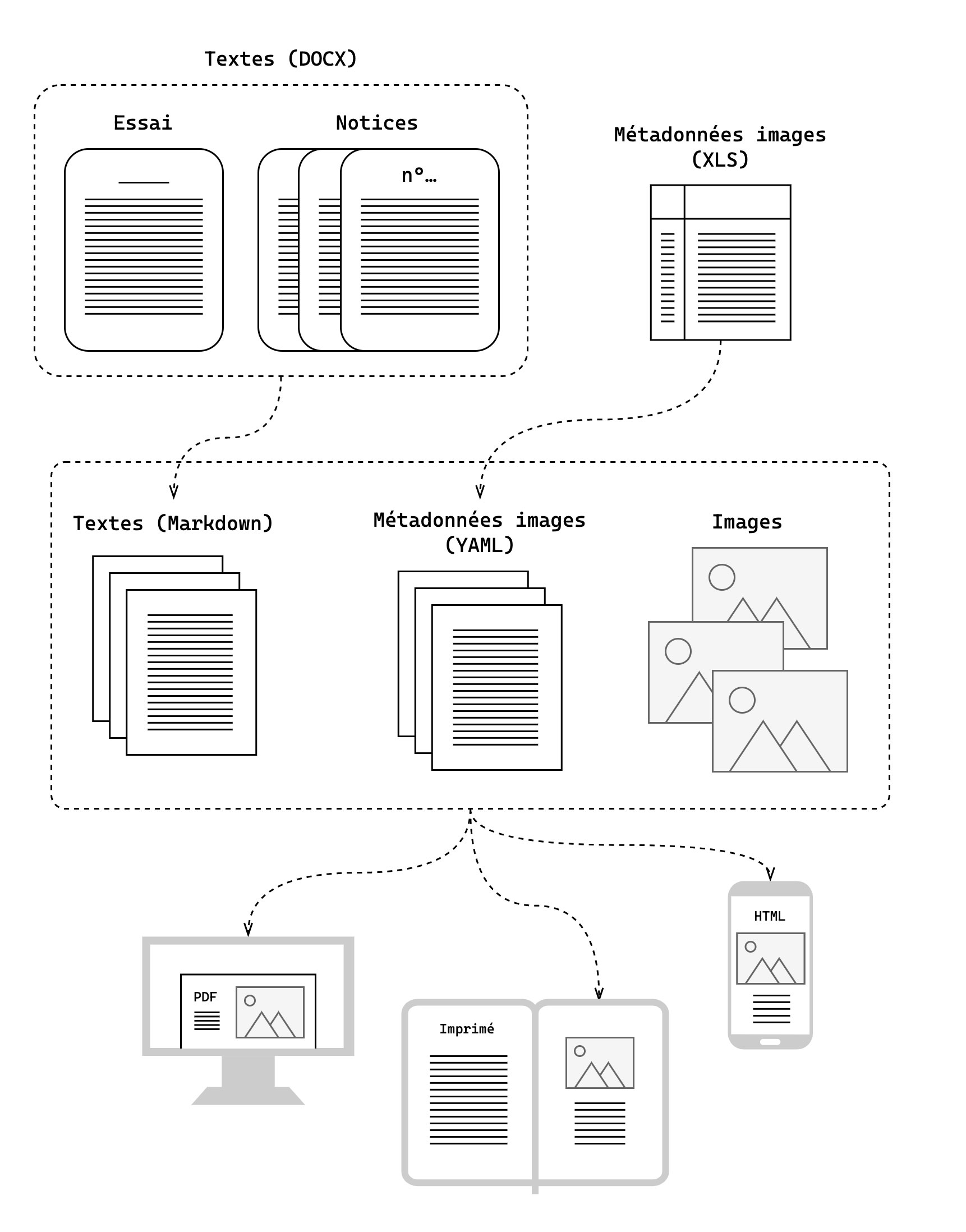
The publishing chain was custom-built and allows tagged Word files to be converted into rich Markdown text files that can be shared via Git. Iconography is managed via YAML. Everything is converted using Flax, Paged.js, and CSS into paper, PDF, or web versions.
An intermediate HTML rendering simulates the appearance of the PDF, allowing for precise adjustments before production. The process follows a sequential and iterative logic, separating content and form without neglecting the latter.
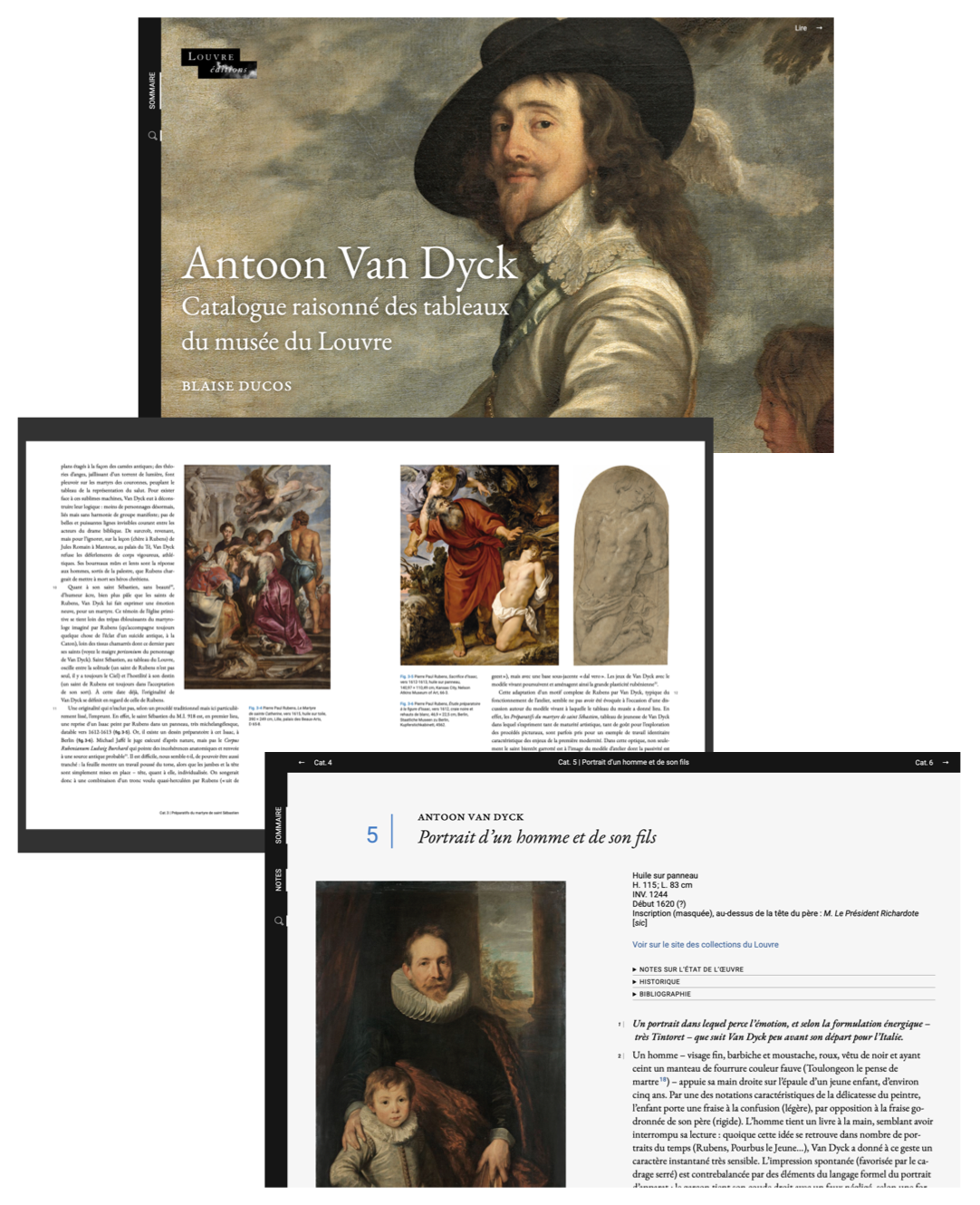
The web design faithfully reproduces the codes of the printed book: cover, table of contents, double pages, typography. The interface promotes intuitive navigation and respects editorial intentions.
The catalog was designed using single source publishing, which allows multiple formats (digital PDF, EPUB, print edition, website) to be produced from a single source file, even though each medium requires specific adaptations.
In an interview conducted by Jean-Christophe Carius, he raises an interesting question: why create a new software solution when some already exist? He cites the example of Quire, a publishing chain with several interfaced components that generate books in different formats. However, to generate PDFs, they use Prince XML, which is proprietary and paid software. This is where Paged.js comes in, as a free and open-source solution that produces PDFs from HTML streams, ensuring free scalability.
We contacted the Getty to ask if we could explore the possibility of replacing Prince XML with Paged.js. The Getty was open to the idea. Then, just as we were getting started, the Getty announced that it was working on making Quire open source, with a complete overhaul and a change in software components (Eleventy instead of Hugo, and Paged.js instead of PrinceXML… which actually corresponded exactly to the technical choices we had intended to make). It would therefore have made no sense to work on a solution that was in the process of being redesigned, and, by coincidence, we found ourselves developing our solution in parallel and arriving at the same conclusions, which reinforced our choices.4
This discussion shows that the various initiatives within the community of people working on these issues are fairly consistent in their choice and design of tools. Nevertheless, it is still unfortunate that the same initiative is being developed in two different places and at two different times, without the possibility of joining forces.
> Graphic design is not free
> PrepostPrint
> Ideology = innovation
> Economically viable for stakeholders
- https://presse.louvre.fr/le-premier-livre-multiformat-du-musee-du-louvre/ ↩
- Taffin Nicolas, Édition multiformat au musée du Louvre, https://inacheve-dimprimer.net/articles/2023-11-28-louvre.html ↩
- Carius Jean-Christophe, Repenser le catalogue raisonné à l’ère de l’édition numérique, Entretien avec Camille Sourisse et Benoît Deshayes autour du catalogue raisonné des tableaux d’Antoon Van Dyck au musée du Louvre, 2024. https://numrha.hypotheses.org/15834 ↩
- Ibid. ↩
Toolchain
Materials : Texts (Docx) > Texts (Markdown) + Images Metadata (XLS) > Images Metadata (YAML) + Images > HTML/CSS/Paged.js > Website + Digital PDF + Ready-to-print PDF
Infos
Type
Catalogue
Author(s)
Blaise Ducos
Designer(s)
Agathe Baëz, Nicolas Taffin, Julien Taquet
Publisher
Musée du Louvre
Printing
On demand, CMYK
Pages
352
Size
245 × 280 mm
Technologies
HTML / CSS / Paged.js / FLax / Eleventy / Git
Year
2023
Language
French
Sitography