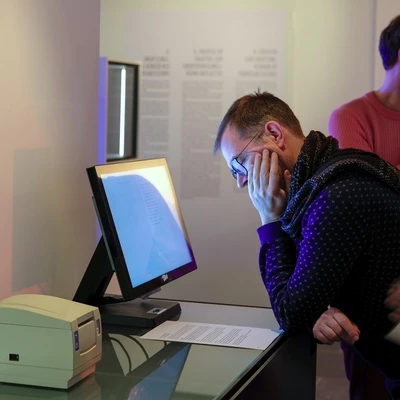
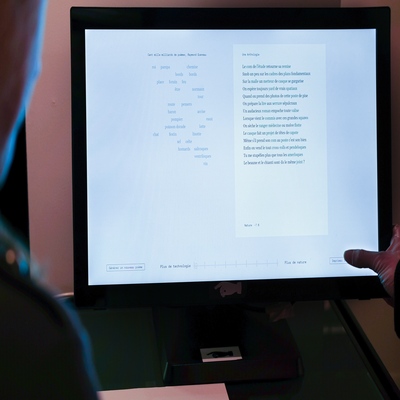
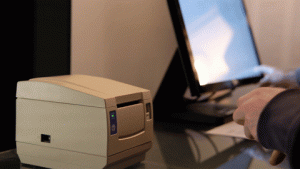
What poems would you like to include in tomorrow’s anthology? This installation allowed the visitor to generate sonnets that highlight nature elements or technologies, or neither. An artificial poet was at work. When visitors were satisfied with the result, they could print the sonnet and take it home.
Inspiration
Each one of us is co-responsible for the images of the future that will shape tomorrow’s world. An Anthology took this as a starting point. Like human artists, this artificial intelligence learned from other authors. It used One Hundred Thousand Billion Poems by Raymond Queneau, to write new sonnets by substituting nouns, respecting the metre and the rhyme. But of course, it made mistakes.
Sources
In order to learn a semantic field of words related to nature and technology, the artificial poet read about 1400 novels by about 100 science-fiction and fantasy authors, including L’Île mystérieuse and other novels by Jules Verne, Guy de Maupassant, Isaac Asimov, Philip K. Dick, Ursula K. Le Guin, but also contemporary authors such as Anne Rice, Haruki Murakami, William Gibson and Iain Banks.
Methods
The artificial poet analysed the novels using a neural network that calculates the linguistic context of words in a multidimensional space. It then relied on Lexique, a corpus of phonemes, gender and number of syllables developed by Boris New and Christophe Pallier of the University of Savoie Mont Blanc. Finally, An Anthologie made the poem physical thanks to Plotto, a pen plotter from the 1980s.
Collaborators
It is not very clear what other trees participated in the training of the artificial poet; what is clear was that there were many more mentions and descriptions of nature in earlier fictions. The human collaborators in this project were designer-programmer Gijs de Heij and tree clerk An Mertens. We created this work on the invitation of Sofiane Laghoouati, curator of Bye Bye Future! at the Musée Royal de Mariemont.
Sources: https://gitlab.constantvzw.org/algolit/mariemont
A big thank you to Sofiane Laghouati, Musée Royal de Mariemont, Christophe Pallier, Antoine Amarilli, Open Source Publishing, Constant.