DiVersions
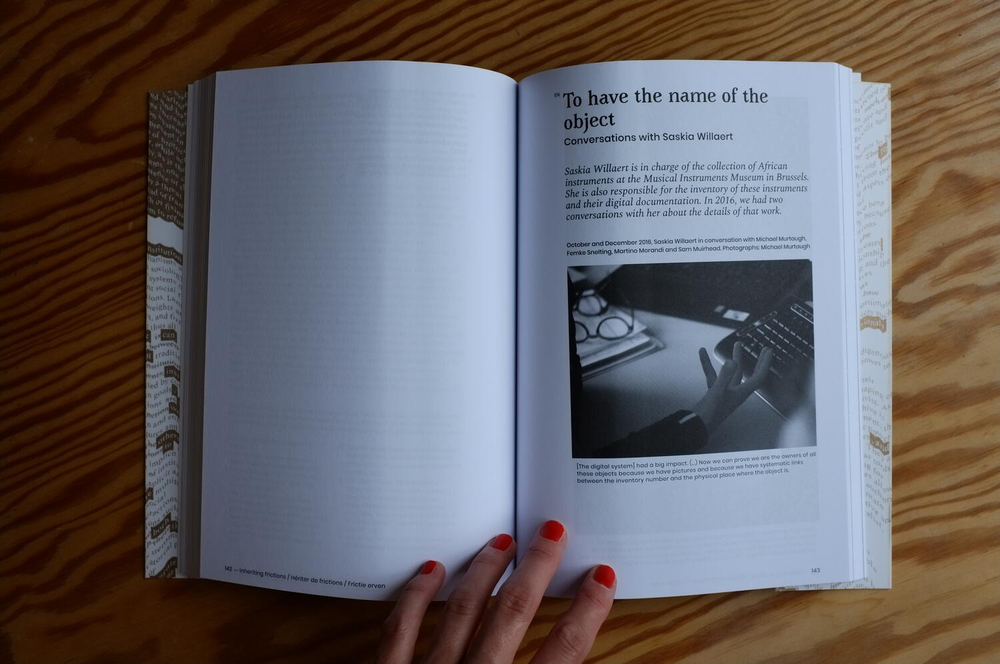
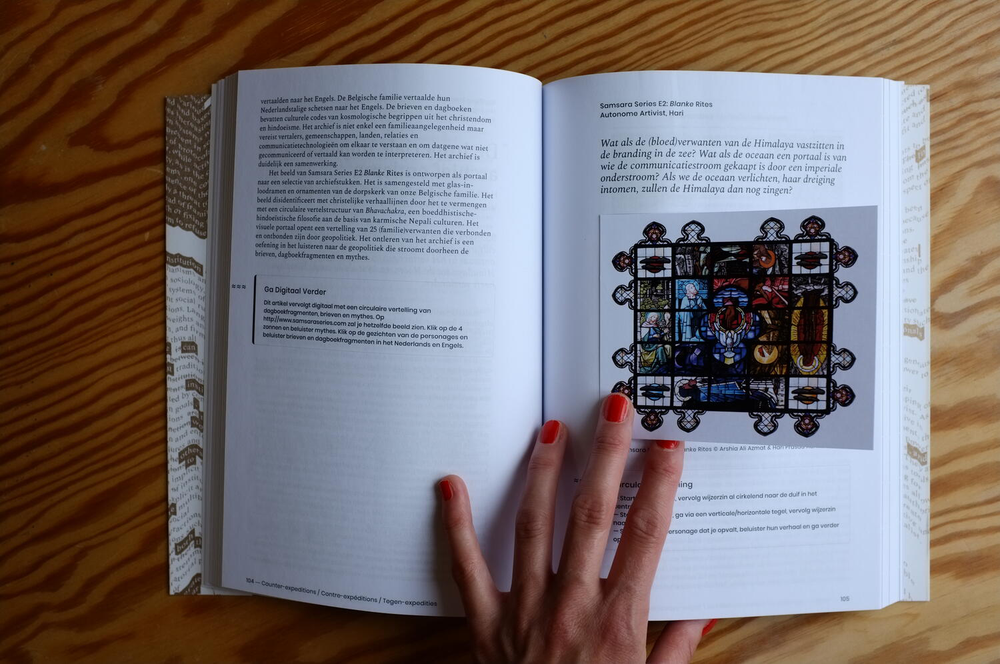
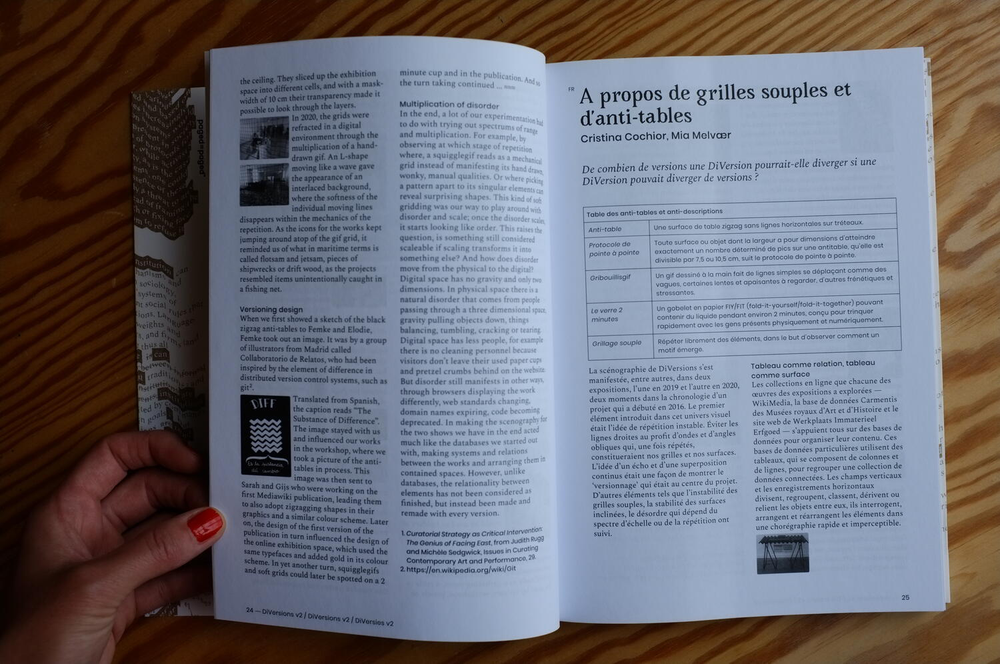
DiVersions has focused on online digital cultural heritage in order to experiment with its potential to invite various forms of collaboration, to reveal conflicts, and to make room for other narratives. In dialogue with cultural institutions and their e-collections, DiVersions experimented with digitized and digital heritage to open up metadata, databases, catalogs, and digital infrastructures to other imaginations.1
The four-year project was organized around seven artistic experiments that evolved in response to digital and digitized collections.
This project is a commitment to decolonial and intersectional perspectives on e-collections. They are considered cultural heritage that can offer a place for marginalized narratives while highlighting the need for awareness of the colonial violence that fuels them, keeps them in place, and marginalizes many points of view.
Behind this publication, therefore, is an acknowledgment of the ambivalence of these objects as tools of resistance, but whose institutional construction places them within the categorization of the world. The criteria used to sort these collections must be carefully considered so that the colonial violence that brought these collections together in the first place does not continue. Digital publication models are not neutral and can perpetuate relationships of domination.
The questions raised revolve around objects such as e-collections, but also around whether metadata prevents or allows for “diversions.” Database technologies affirm the authority of certain experts over others, and algorithms corroborate sexist stereotypes. These issues need to be addressed, otherwise digitization will keep conservation, representation, and access in the hands of colonial powers.
“Versioning” is a practice that allows multiple people to write content and easily modify what has already been written. This has the advantage of offering numerous opportunities for intervention and response, thereby promoting divergent narratives.
The idea is to make the shared editing process transparent, where any action can be undone or redone, taking differences into account. Versioning emphasizes the process and makes it almost never-ending.2
One of the limitations of versioning is the assumption of linearity, which too easily confirms a sense of progressive evolution, especially when the latest version is considered the best. How can versions be expressed in terms of stops, U-turns, parallel tracks, bumps, and slips that occur throughout a process ?
This is where the potential of a decolonial and intersectional approach to versioning emerges. By offering different points of intervention, it opens up a culture of criticism and offers avenues for rethinking, re-situating, and reorienting. Thus, decolonial versioning allows different versions to coexist but also to interact, taking into account all the complexity associated with heritage.
Envisioning other narratives means opening up digital collections and their histories as a collective writing, an understanding of heritage that is neither individually owned nor arranged in a linear fashion.3
- https://diversions.constantvzw.org/wiki ↩
- Misselyn Ségolène, DiVersions V2, le projet numérique qui veut entendre plus de voix, RTBF, 2021 ↩
- https://diversions.constantvzw.org/wiki/index.php?title=Introduction#introduction ↩
Toolchain
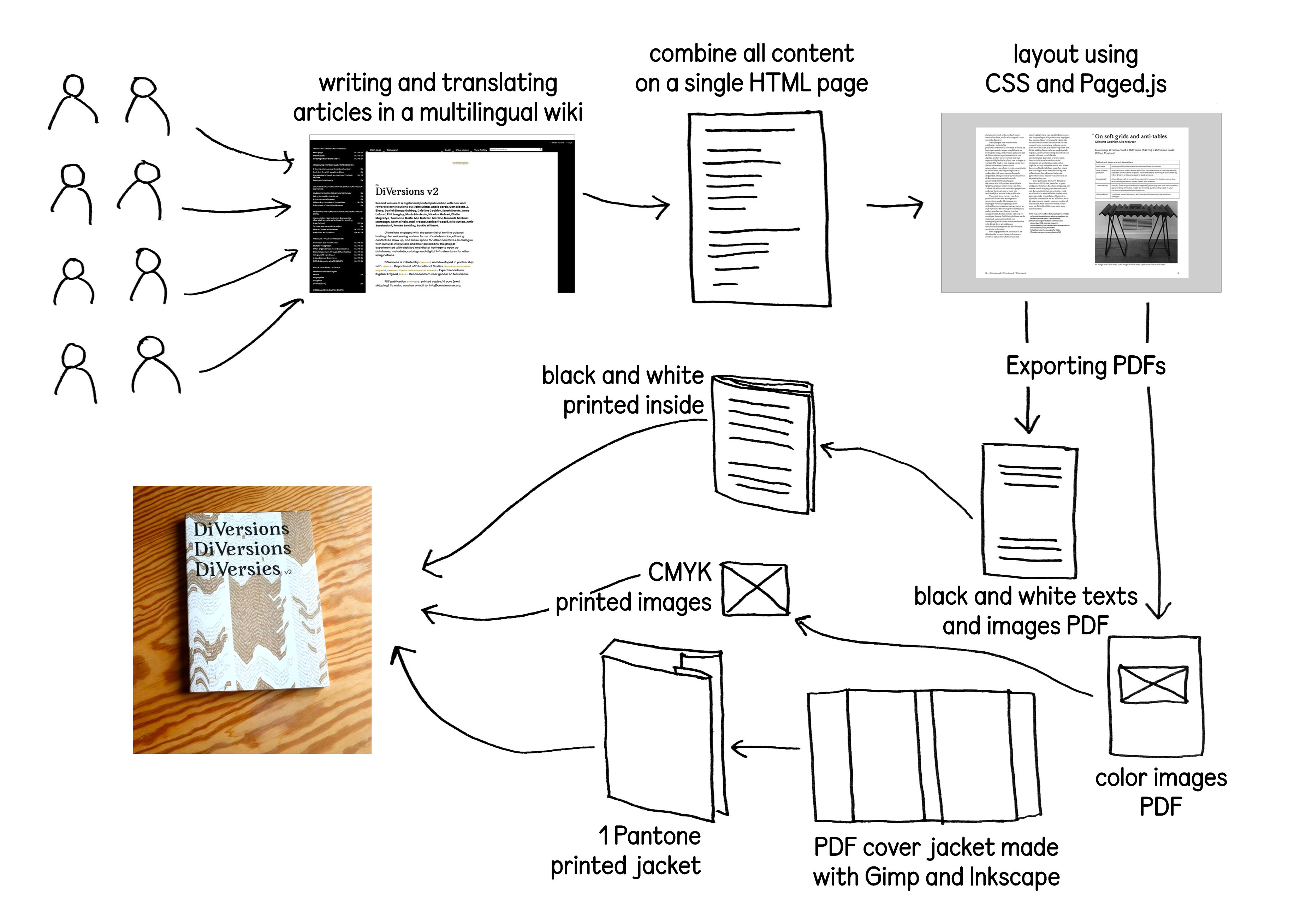
Gimp (for creating images) + Text > MediaWiki > HTML / CSS / Paged.js > Ghoscript /MuPDF / PDFtk > PDF > Print
Infos
Type
Book
Author(s)
Rahel Aima & Anaïs Berck & Gert Biesta & Z. Blace & Daniel Blanga Gubbay & Cristina Cochior & Sarah Kaerts & Anne Laforet & Phil Langley & Marie Lécrivain & Nicolas Malevé & Elodie Mugrefya & Zoumana Meïté & Mia Melvær & Martino Morandi & Michael Murtaugh & Colm o’Neill & Hari Prasad Adhikari-Sacré & Kris Rutten & Amir Sarabadani & Femke Snelting & Saskia Willaert
Designer(s)
OSP (Gijs de Heij, Sarah Magnan)
Publisher
Constant
Printing
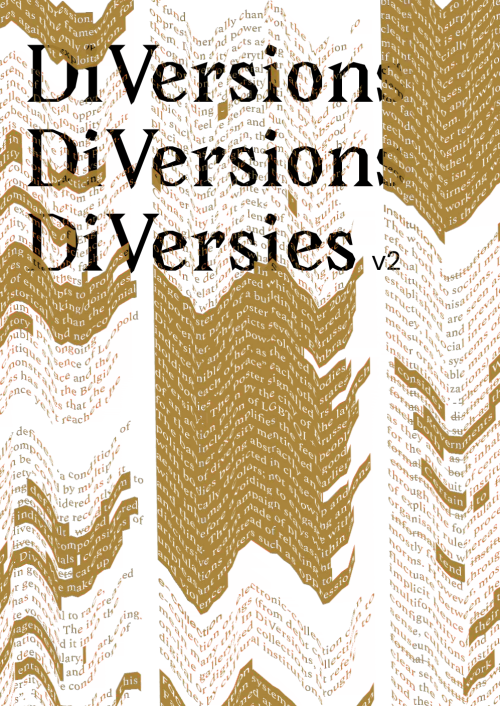
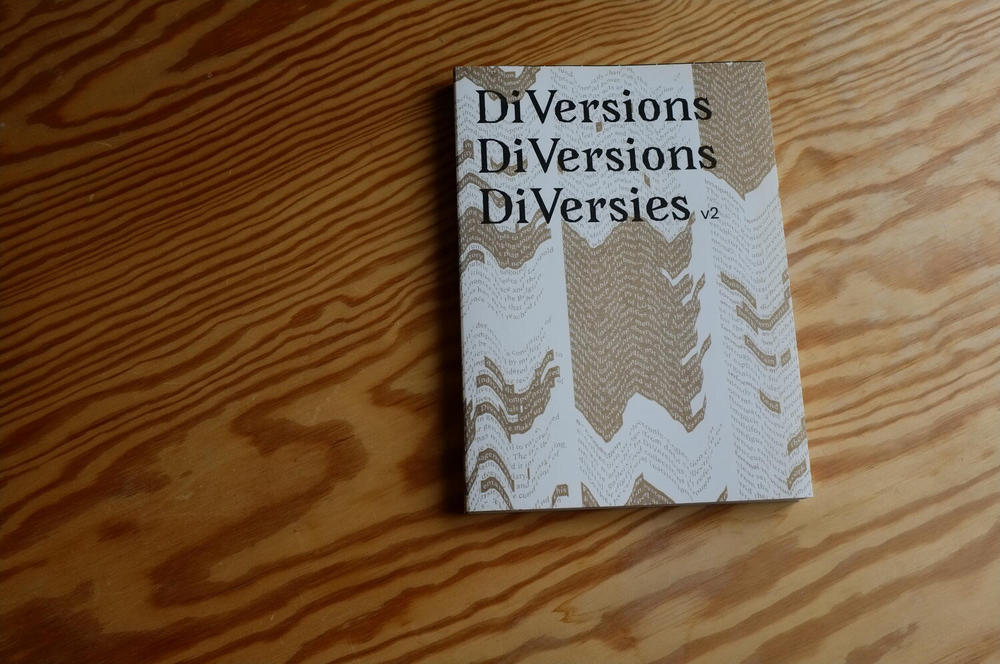
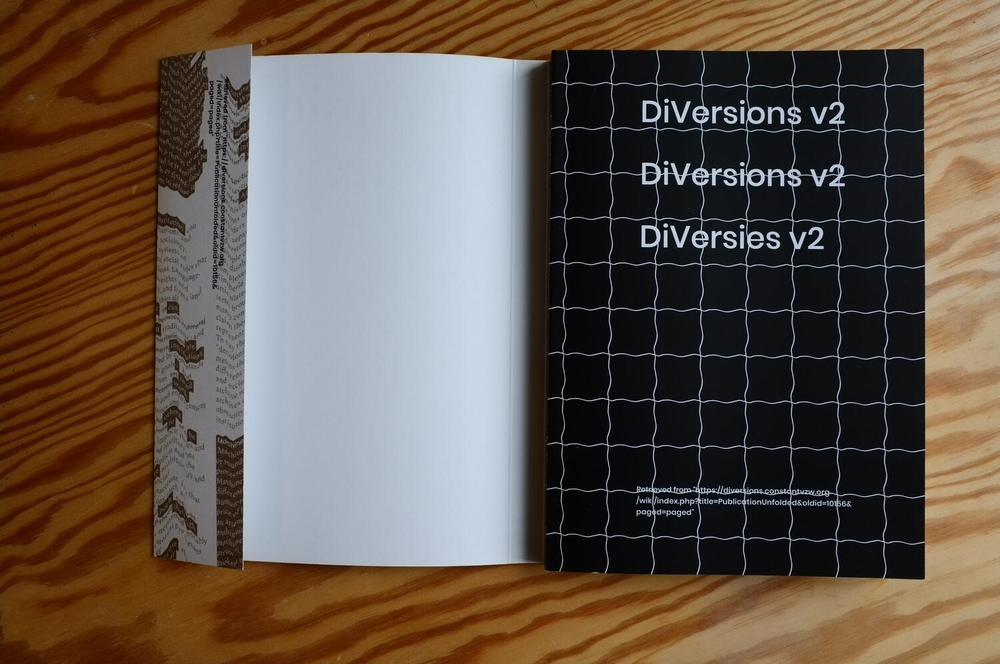
Offset black and white + CMYK images + 1 Pantone for cover
Pages
256
Size
210 × 297 mm
Technologies
MediaWiki, HTML, CSS, Paged.js, firefox, Gimp, Ghostscript, MuPDF, PDFtk
Year
v1: 2020 / v2: 2022
Language
Néerlandais, Anglais, Français
Printer
Graphius, Harry Studio (dust jacket), AJM Print-Shop (color pictures)
License
Texts and images developed by DiVersions are available under the Collective Conditions for Re-Use (cc4r) 1.0
Sitography
Authors
Translators
Designers / Developpers : Open Source Publishing (Sarah Magnan & Gijs de Heij)
Designers / Developpers : Open Source Publishing (Sarah Magnan & Gijs de Heij)
Designers / Developpers : Open Source Publishing (Sarah Magnan & Gijs de Heij)
Graphius, Harry Studio (dust jacket), AJM Print-Shop (color pictures)
MediaWiki
Gimp
Wiki-to-Print
HTML
Paged.js
HTML
CSS
Firefox
Ghostscript
MuPDF
PDFtk
Writing
Translating
Creating images
Add data in the Wiki
Transforming the Wiki into a one HTML page
Layout with Paged.js for pagination and CSS for the design
Exporting PDF with Firefox
Converting RVB PDF to ready-to print PDF
Printing
Binding
An HTML Page
A RVB PDF
1 black and white PDF for the inside
1 CMYK PDF for color images
1 Pantone PDF for the cover
A book
Collecting data
Authors
Translators
MediaWiki
Gimp
Writing
Translating
Creating images
Add data in the Wiki
Transforming data
Designers / Developpers : Open Source Publishing (Sarah Magnan & Gijs de Heij)
Wiki-to-Print
HTML
Transforming the Wiki into a one HTML page
An HTML Page
Layout
Designers / Developpers : Open Source Publishing (Sarah Magnan & Gijs de Heij)
Paged.js
HTML
CSS
Firefox
Layout with Paged.js for pagination and CSS for the design
A RVB PDF
Exporting
Designers / Developpers : Open Source Publishing (Sarah Magnan & Gijs de Heij)
Ghostscript
MuPDF
PDFtk
Exporting PDF with Firefox
Converting RVB PDF to ready-to print PDF
1 black and white PDF for the inside
1 CMYK PDF for color images
1 Pantone PDF for the cover
Printing
Graphius, Harry Studio (dust jacket), AJM Print-Shop (color pictures)
Printing
Binding
A book