Éditer aussi
Faire émerger des récits-compagnons
ÉDITER AUSSI est un projet de recherche et de coopérations artistiques avec pour intention d’explorer de nouvelles formes de création, d’édition et de diffusion de « récits-compagnons ».
Ce qui pourrait se traduire par…
Le choix de travailler, créer, collaborer avec des outils appropriés pour sortir des chaînes de dépendances complexes et verticales de la fabrique du livre,
Une réflexion sur la notion d’outil-compagnon pour questionner la place des outils dans l’émergence des récits (et vice-versa) et accompagner des mises en récit plurielles
L’expérimentation d’outil Web-to-print auprès de différents publics et différents terrains pour produire autant que valoriser des récits porteurs d’alternatives et de diversité,
Une attention portée sur la circulation, l’activation, l’amplification et la collection de ces récits tout autant que sur des façons de penser et faire issue des cultures numériques frugales, libre et open source.
ÉDITER AUSSI se niche ainsi dans différents « milieux » de culture :
« Cultures numériques frugales » Réflexion, conception et usages de services numériques plus sobres ou intégrant une modération dans les pratiques au quotidien.
« Design graphique et éditorial » Entre papier et écran, narration et production graphique, le design éditorial permet d’expérimenter avec les modalités et matérialités de lecture-écriture.
« Arts du récit et de l’enquête » Émergence de récits communs grâce à des protocoles collaboratifs et de méthodologie de recherche narrative.
ÉDITER AUSSI est lauréat de l’appel à projet du CR! - co-produit dans le cadre de Bourges Capitale Européenne de la Culture 2028. Il est porté par Catherine Lenoble, avec la complicité de Sarah Garcin et Dieudonné Cartier. Il s’ouvre à différentes contributions et s’active à de multiples échelles :à Tours, à Bourges, en région Centre, dans des Capitales européennes de la culture, en ligne/en réseau.
En quête de web frugal et de récits-compagnons
Travel-to-print en Croatie
Rewilding Cultures vise à initier une conversation sur les échanges culturels et offre des bourses de mobilité au-delà des formes actuelles, ainsi qu’un soutien aux travaux et aux expériences qui contribuent à repenser la mobilité et les échanges culturels de manière novatrice. Catherine Lenoble est l’une des lauréates 2025 de la bourse Rewilding Cultures.
Catherine Lenoble est une travailleuse du texte, des arts hybrides et des communs. Parallèlement à son activisme culturel au sein de communautés créatives (hacklab, fablab, medialab, édition, cyberféminisme), elle développe un espace de recherche-création qui interroge notre façon de lire écrire éditer en environnement numérique. Depuis 2010, elle crée des objets éditoriaux et/ou fictionnels, web et/ou print, in situ et/ou en ligne, sous la forme de publications, performances, installations, ateliers. En 2022, elle co-initie avec l’artiste Dieudonné Cartier le PrintLab, un atelier dédié à l’impression riso et la micro-édition au sein d’un fablab à Tours pour explorer d’autres façons de penser fabriquer des éditions.
Pour l’amour du print, des courts-circuits et des récits à la marge.
Elle est partie rencontrer en Croatie les initiateur.ices de Pirate Care (Valeria Graziano, Marcell Mars, Tomislav Medak et Davor Mišković) un projet de recherche transnational et réseau d’activistes, d’universitaires et de praticien.nes qui s’opposent à la criminalisation de la solidarité et plaident en faveur d’une infrastructure de soins commune.
Valeria Graziano (théoricienne de la culture, activiste, chercheuse) participe à des initiatives de recherche dans le secteur culturel et les mouvements sociaux, axés pédagogie populaire et politique des loisirs, pratiques de réparation et refus du travail gratuit, soins et piratage.
Marcell Mars (activiste, chercheur indépendant, artiste) est à l’origine de projets ayant contribué au développement des communs en Croatie et au-delà, tels que Public Library et Memory of the world, des infrastructures socio-techniques créées pour faciliter l’accès universel à la connaissance.
Tomislav Medak est un membre fondateur de l’équipe théorique et éditoriale de l’Institut Multimédia/MAMA à Zagreb où il organise depuis 2000 des conférences, des colloques et des expositions, et publie des ouvrages sur l’économie politique, les médias tactiques et les biens communs.
Davor Mišković est le directeur de Drugo more une organisation à but non lucratif implantée à Rijeka qui produit, promeut, recherche et diffuse une culture d’intérêt général avec et pour les communautés. Sa programmation se situe dans les intersections entre arts, sciences et société.
Et si… ?
Et si l’on pouvait faire un (ou des) pas de côté en matière de mobilité culturelle et artistique, qu’est-ce que l’on « s’autoriserait » à faire ?
En vérité il ne m’a pas fallu longtemps pour formuler une proposition, encouragée par le format original de la bourse Rewilding Cultures.
Partir en train.
Prendre le temps.
Voyager avec un outil d’édition Web-to-print.
Rendre visite à des artistes-chercheur.euses en Croatie partageant des intérêts complices sur ces pratiques (outils de publication, savoirs ouverts, soin des infrastructures techniques).
Et vivre cette aventure avec mon fils.
Voilà comment nous sommes parti.es pendant 12 jours au mois d’août avec Yuri, 8 ans, direction la Croatie.
Éditer aussi
Cela faisait un moment que je souhaitais expérimenter davantage des projets croisant micro-édition et technologies Web-to-print afin de continuer à cultiver des productions éditoriales curieuses. Le Web-to-print allie : « l’utilisation des techniques du web (langages html, css et js) pour produire depuis le navigateur un fichier pdf destiné à l’impression, l’utilisation d’outils libres et open source pour la création graphique et l’utilisation de programmation et de scripts pour la mise en page ».
Ces pratiques font leur révolution invisible dans un système dominé par des chaînes éditoriales verticales, commerciales, propriétaires. Elles sont le fait de communauté d’artistes, designers, collectifs très actifves en Belgique, aux Pays-Bas et en France. Iels s’inscrivent dans un continuum de réflexions issues du « permacomputing », mouvement à la croisée des arts numériques, du hacking et du web-design qui prône des outils plus sobres et des pratiques respectueuses des ressources. Le « permapublishing » en est sa déclinaison dans le champ de l’édition et du design graphique.
Sarah Garcin est l’une de ces têtes fouineuses, artiste-designer membre de l’Atelier des chercheurs et du collectif Prepostprint, qui explore les sentiers alternatifs de la publication (et tout un tas d’autres pratiques conviviales allant de la cuisine, à la radio, et plus récemment la chanson technocritique !).
« Allo Sarah? ». Nous avions déjà collaboré dans le passé, nous reprenons le fil de nos projets, je lui partage alors cette envie/idée de compagnonner avec un outil de publication (pouvoir faire de l’édition et de la mise en récit de contenus « tout terrain », in situ ou en train). Un mois plus tard nous nous retrouvons à La Générale à Paris en juillet pour une session de travail, prête à tester un « outil-compagnon » pour le voyage qui approche.
Les aventurierEs du rail
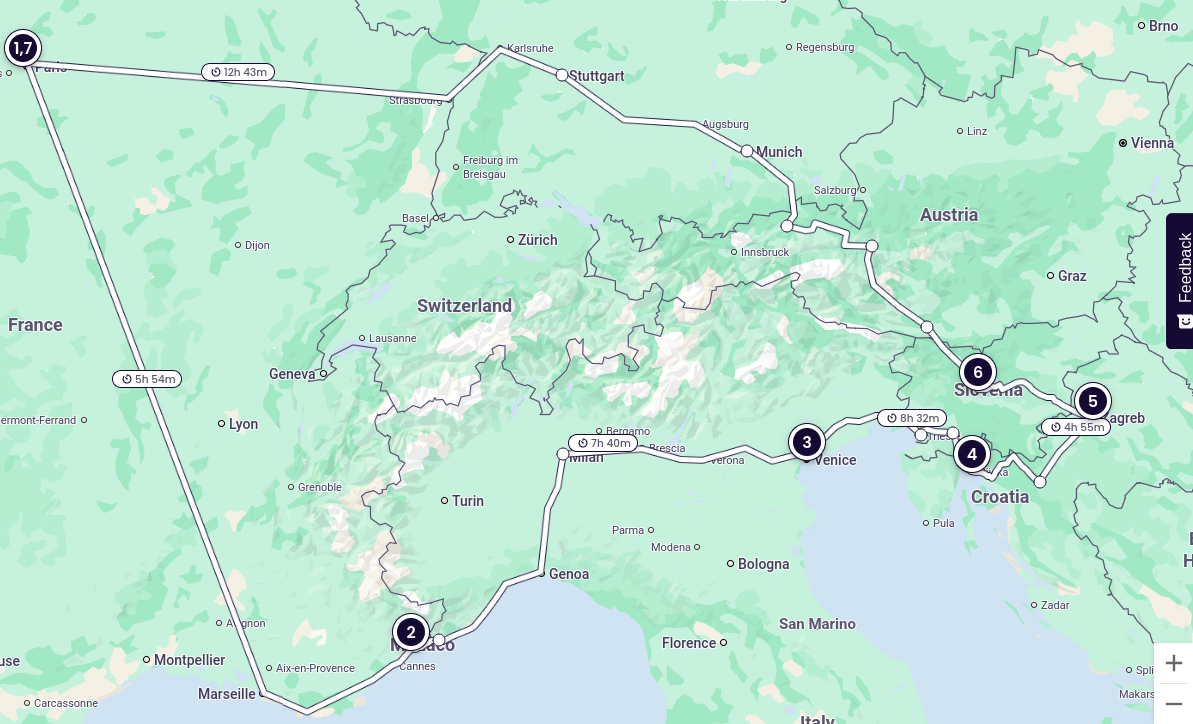
Le voyage a commencé en train de nuit par le Paris-Nice, cette mythique ligne qui longe la côté méditerranéenne au lever du jour.
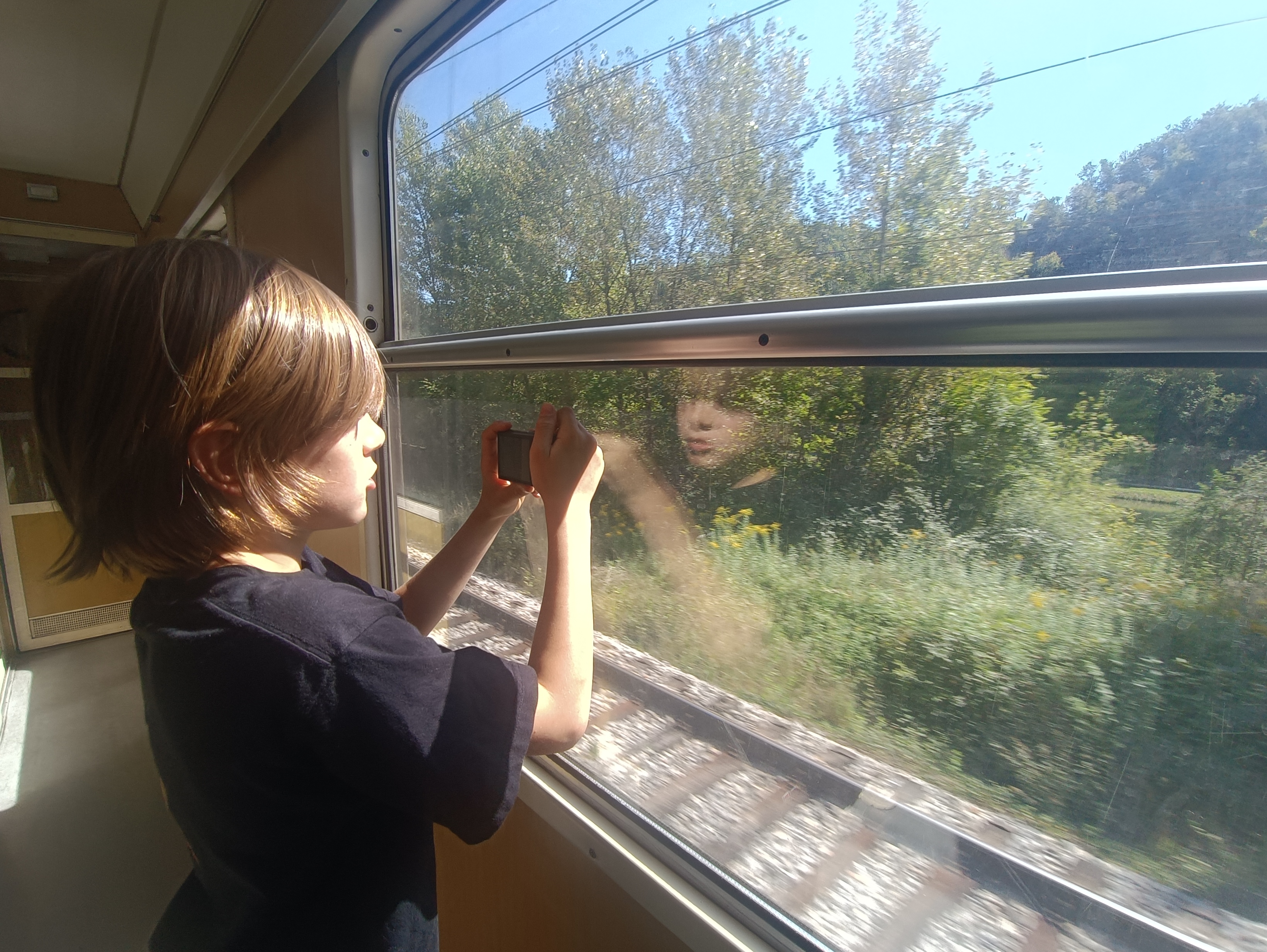
Il y a ce quelque chose de différent lorsque l’on voyage avec un enfant.
Ce qui se passe à hauteur d’yeux.
Ce qui est regardé questionné désiré.
Ce qui s’écoute et se goûte.
Ce qui se crée.
Il nous faudra une journée de plus pour traverser toute l’Italie du nord et rejoindre Venise en soirée. L’arrivée en train à Venise, entre terre et mer, est toujours aussi magique. Nous y ferons étape pour 3 nuits sur l’île de la Giudecca.
De Venise à Rijeka, le voyage nous réserve sont lot de surprises. Il n’y a plus de train pour passer la frontière de l’Italie vers la Slovénie, ce sera un bus de Trieste vers Sežana, puis un train direction Pivka, hub rural où l’on attendra la dernière connexion ferroviaire pour Rijeka.
Ville industrialo-portuaire de la côte adriatique, Rijeka est restée longtemps sous la souveraineté des Habsbourg, avant d’être occupée par l’armée italienne, devenir un éphémère État Libre du Fiume, puis être annexée par l’Italie. Elle sera reprise par les troupes de Tito et annexée à la Yougoslavie après la seconde guerre mondiale avant de proclamer son indépendance en 1991. Son héritage est un mille-feuille culturel. Elle devient Capitale européenne de la Culture en 2020.
Conversations
Nous restons une semaine en Croatie, principalement à Rijeka puis Zagreb. Les journées s’organisent de façon fluide au gré des disponibilités de Davor, Valeria, Marcell et Tomislav, l’équipe de Pirate Care. Avec chacun d’entre elleux, une conversation s’engage autour de nos activités communes et des savoirs militants qui en découlent (dans des lieux-laboratoire, avec des outils et infrastructures techniques ouvertes, des réseaux alliés en Europe, des pratiques éditoriales et des publications collectives).
Première rencontre dans les locaux de Drugo More accueilli par Davor et Barbora. Yuri s’installe avec son tome 2 d’Harry Potter pendant que nous traversons aussi des temps passés présents futurs. Crée en 1999, Drugo More c’est un bon quart de siècle d’activisme culturel, de médias tactiques et d’arts hybrides à travers leurs activités de médiation, d’actions citoyennes, de festivals, d’expos et de workshops.
Autour de la table, du café, des publications et des fanzines imprimés en riso. Le hors-série MCD L’Europe des medialabs est notre notre relique (j’en ai assuré la coordination éditoriale… en 2011 et Drugo More y a contribué), une archive en commun que l’on feuillette. Malgré les crises multiples, certains de ces labs et collectifs sont toujours debout. « Ça tient », encore, souvent à travers des coopérations artistiques et le soutien de programmes européens.
C’est d’ailleurs dans le cadre du projet européen « Figure it Out – L’art de vivre à travers les failles du système » que nous nous sommes toustes rencontré.es ou retrouvé.es en juin 2024 lors du festival Re/Dé}connecte co-organisé avec Labomedia à Orléans. Finalement, en août 2025, nous ré-ouvrons les conversations entamées un an plus tôt. Entre temps, les projets Figure It Out et Pirate Care sur lequel toustes travaillaient sont clôturés et ont donné lieu à des publications.
Avec Valeria et Marcell, les discussions ont lieu en terrasse de café, chez eux, lors de repas collectif ou à la plage, les enfants sont avec nous (Yuri et Maté le fils de Valeria et Marcell). Nous échangeons des bouquins, nous ouvrons les ordinateurs pour se montrer des outils, nous partageons nos expériences de développement de base de données et autres bibliothèques de contenus pour lesquelles il y aura eu de la sueur des erreurs et bien sûr des petits bonheurs. Nous évoquons également ces communautés de pratiques en commun (Constant), ces autres collections (Monoskop) et initiatives de web frugal (Low tech magazine) qui re-donne énergie et inspiration pour maintenir au long cours des démarches aussi exploratoires qu’engagées.
Valeria et Marcell reviennent notamment sur leurs recherches à l’intersection du « care » et de la « piraterie » et le travail qu’ils ont mené autour du site syllabus.pirate.care. Sous la forme de syllabus (supports de cours), ce site sobre et statique introduit des pratiques d’auto-organisation et de mise en commun d’outils, de technologies et de savoirs, pour offrir une solidarité inconditionnelle aux personnes les plus exploitées et discriminées. Ces contenus (théoriques et pratiques) destinés à être activés, adaptés, enrichis, sont adossés à un autre outil développé par Marcell et Tomislav, Memoryoftheworld, un réseau de bibliothèques interconnectées qui rend accessibles une giga-collection de livres au format numérique.
Nous quittons Rijeka pour rejoindre Zagreb. Nous y sommes accueillis par Tomislav membre fondateur de l’Institut Multimedia/club MaMa, un lieu facilitateur de rencontres entre hackers, artistes, philosophes, DJ, activistes, créée en 2000. C’est ici que Tomislav et Marcell initient le label d’édition EGOBOO.bits sous licence GNU GPL, ainsi que de nombreux événements et expositions autour du hacking et des cultures numériques.
Tomislav évoque la place qu’a toujours occupé dans leurs projets le livre, sa circulation, sa digitalisation et ses infrastructures in/visibles que sont les bibliothèques. Avec Marcell, ils militent pour une nouvelle forme de bibliothèque publique (programme Public Library) composée de bibliothèques privées interconnectées (projet Memory of the world). Leur démarche s’accompagne d’outils de partage de livres, de campagnes de numérisation des savoirs menacés avec un bookscanner et d’expositions, comme « Paper Struggles » (luttes de papier) en 2020.
La bibliothèque publique est ainsi pensée comme un outil narratif critique pour susciter le débat sur le régime de la propriété intellectuelle, les inégalités d’accès à la culture, à la science et à la recherche, ou encore le monopole de la digitalisation par les grandes plateformes.
Travel-to-print
Ce qui résonne avec d’autres formes d’hégémonies que l’on retrouve ailleurs dans la chaîne du livre, du côté des pratiques éditoriales et graphiques, dominées par des logiciels d’édition propriétaire (Adobe). Partant du constat qu’en France «Les formations publiques conduisent les étudiants à devenir dépendants de ces outils propriétaires, fermés, coûteux et utilisés par un marché du travail qui aimerait s’en passer… mais ne trouve personne formé aux outils alternatifs », des écoles d’art, des écoles d’ingénieurs et des universités européennes se sont réunis autour d’un projet de recherche en commun EPE (Écran Papier Édition) pour concevoir des outils logiciels éditoriaux innovants, raisonnés et durables, sous licence ouverte, pour une approche alternative et créative entre l’écran et le papier.
Sarah Garcin travaille actuellement sur un état de l’art technique des dispositifs web to print dans ce cadre.
Car oui il y en a !
Viva la technodiversité.
Ça y’est, nous bouclons le voyage : du club Mama, Tomislav nous dépose à la gare de Zagreb, direction Ljubljana, capitale de la Slovénie, où nous passerons quelques heures en attendant le train de nuit direction Munich, puis Paris.
De toutes ces trajectoires et conversations, de cette (en)quête et de ces premiers tests avec un outil Web-to-print, l’idée est de publier un récit-compagnon venant prolonger cet article pour entremêler journalisme culturel, savoirs sensibles et ressources documentaires. Un objet web et print. Écran et papier. Pour explorer d’autres façons d’éditer, imprimer et amplifier des récits (col)porteurs de ces alternatives.
-
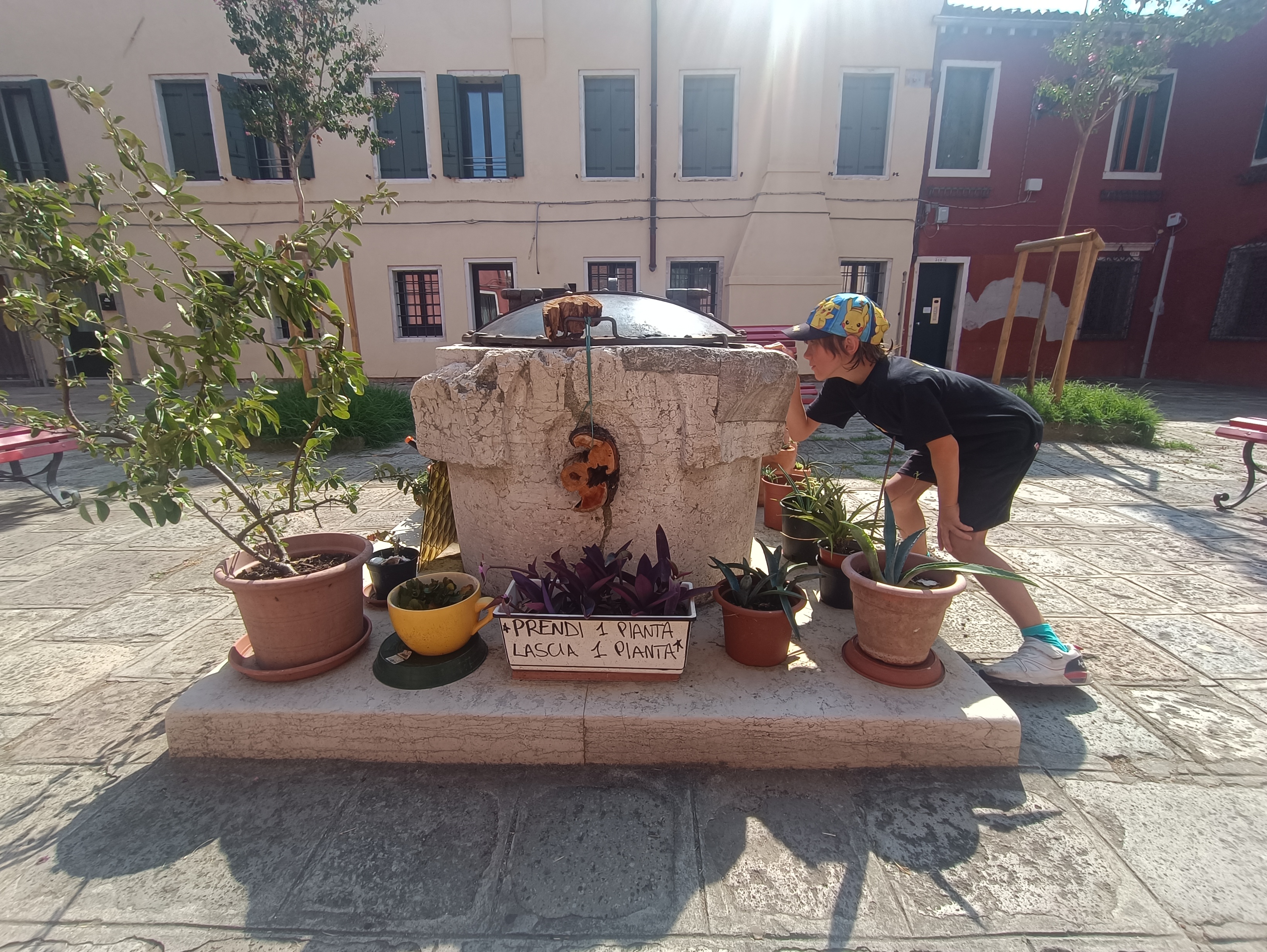
Venise. Ile de la Giudecca. À hauteur d’yeux (en quête de lézards).
Venice. Giudecca Island. At eye level (in search of lizards). -
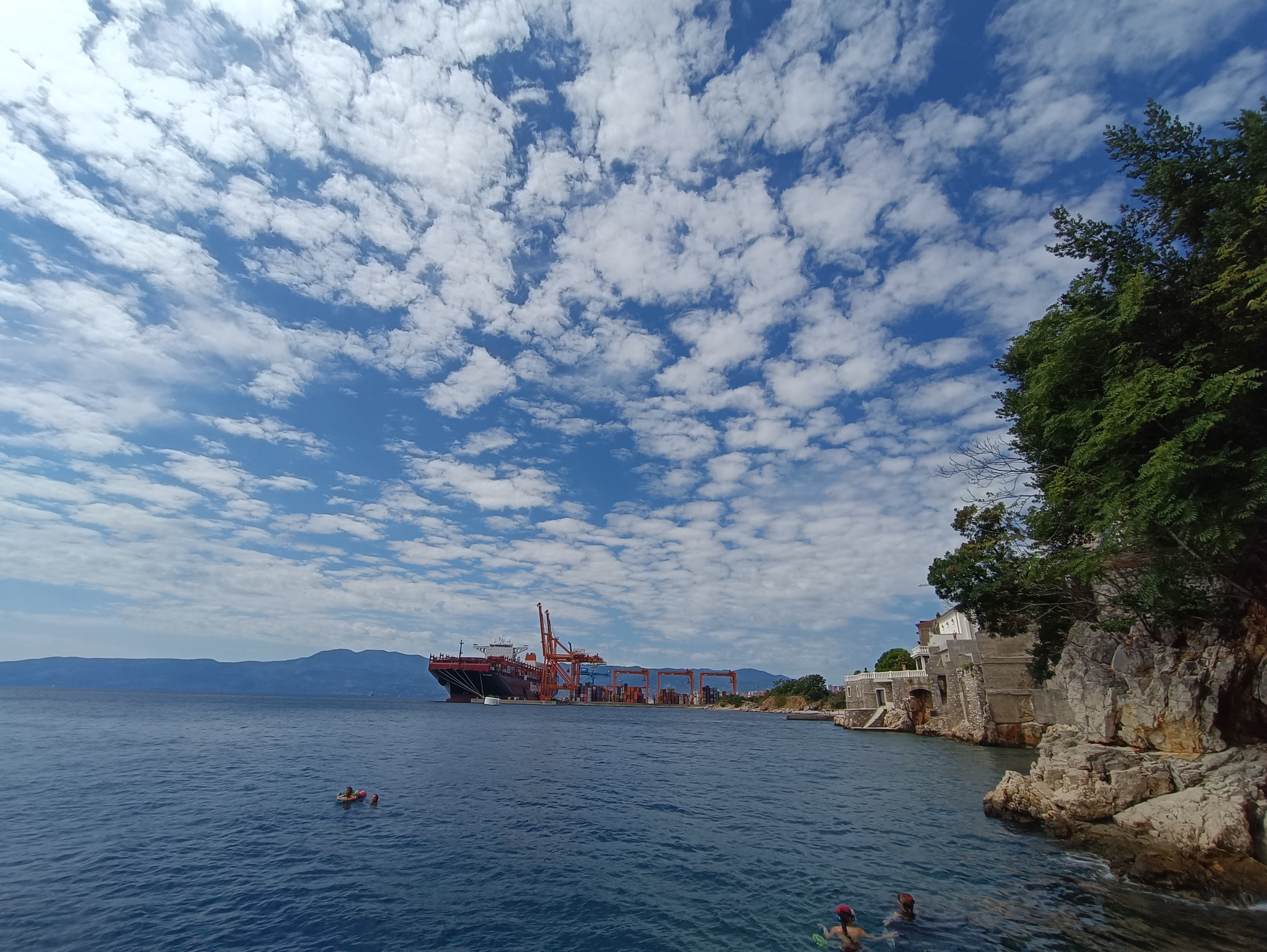
Le port de Rijeka fut la porte d’entrée du royaume de Hongrie au XIXe et début XXe en baie de Kvarner sur la côte adriatique. Il est aujourd’hui encore le plus grand port de Croatie.
The port of Rijeka was the gateway to the Kingdom of Hungary in the 19th and early 20th centuries in Kvarner Bay on the Adriatic coast. Today, it remains Croatia’s largest port.
-
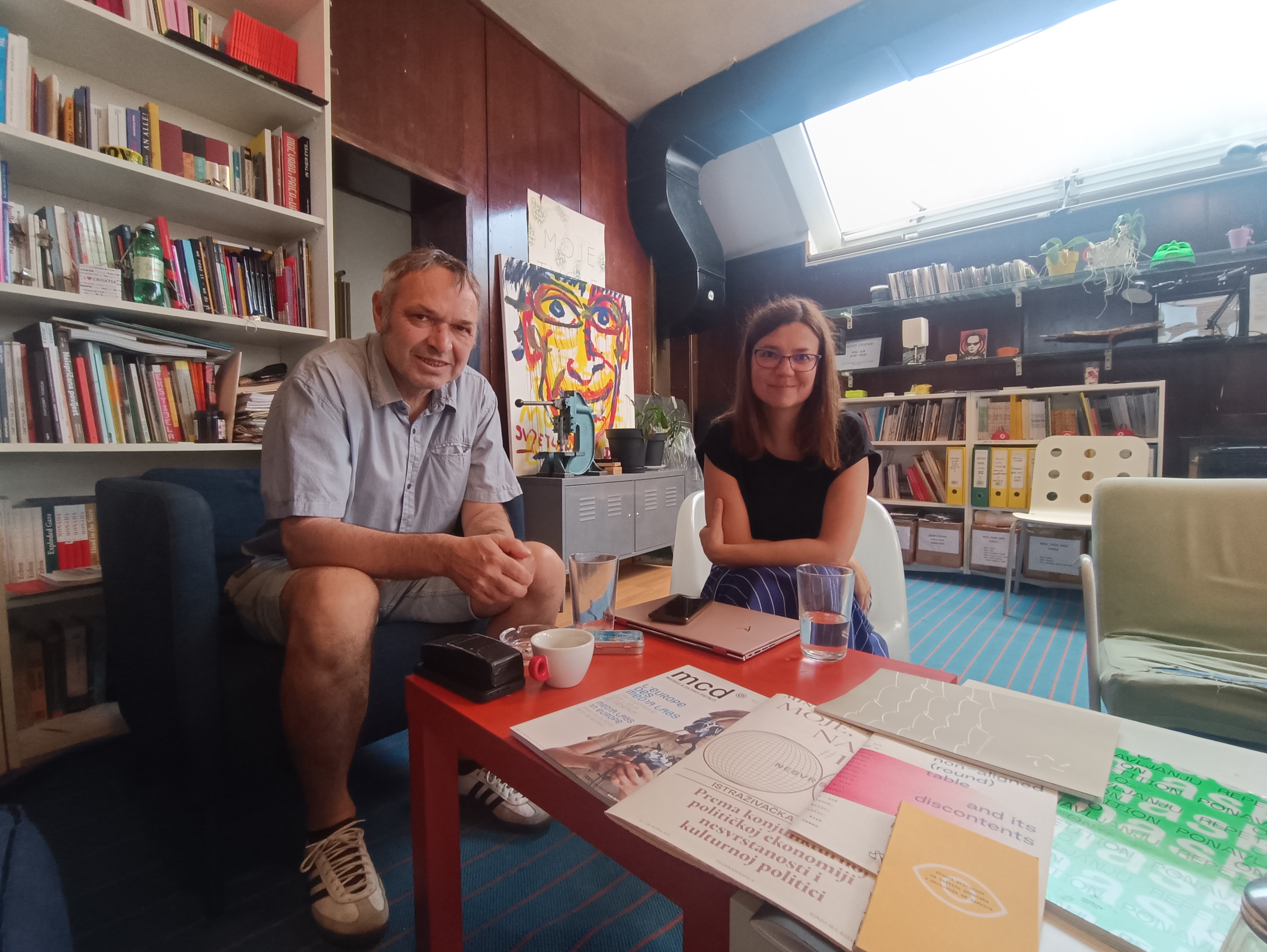
Dans les bureaux de Drugo More côté bibliothèque.
In Drugo More office, on the library side. -
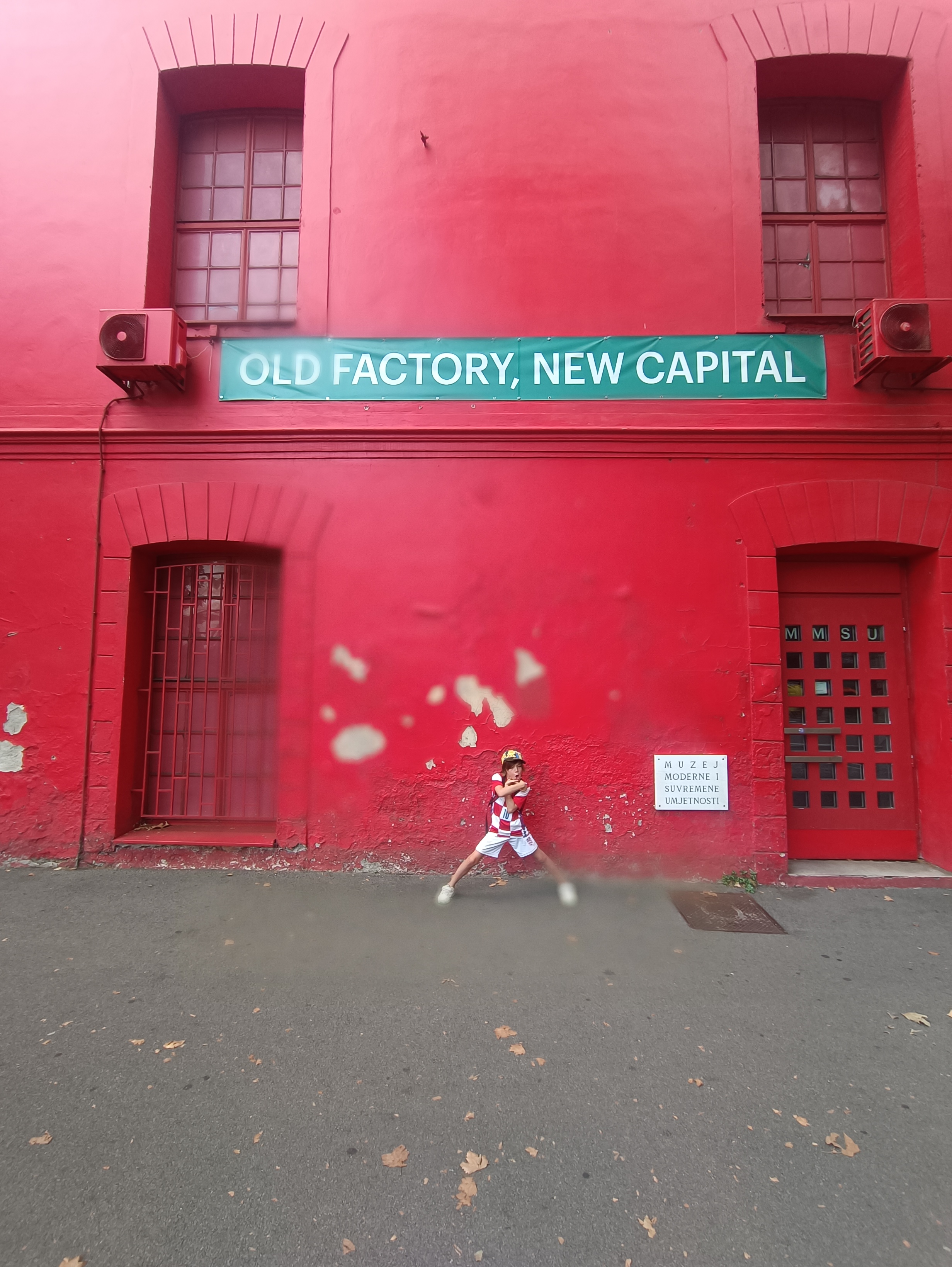
Devant le musée de la ville « Rijeka City Museum – The Sugar Palace » (ancienne raffinerie de sucre).
In front of the city museum ‘Rijeka City Museum – The Sugar Palace’ (former sugar refinery).
-
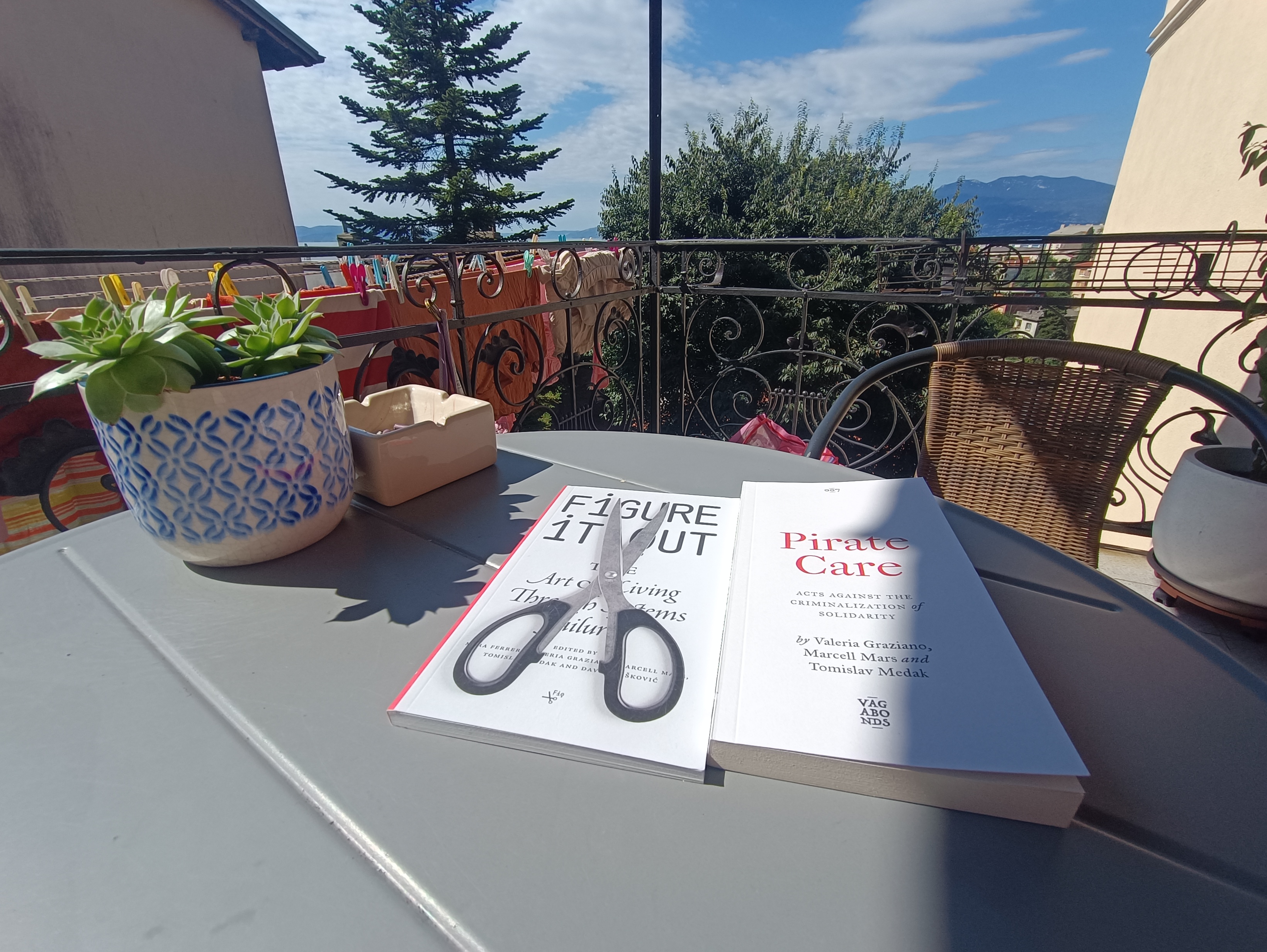
« When everyone is librarian, library is everywhere » (Memoryoftheworld).
-
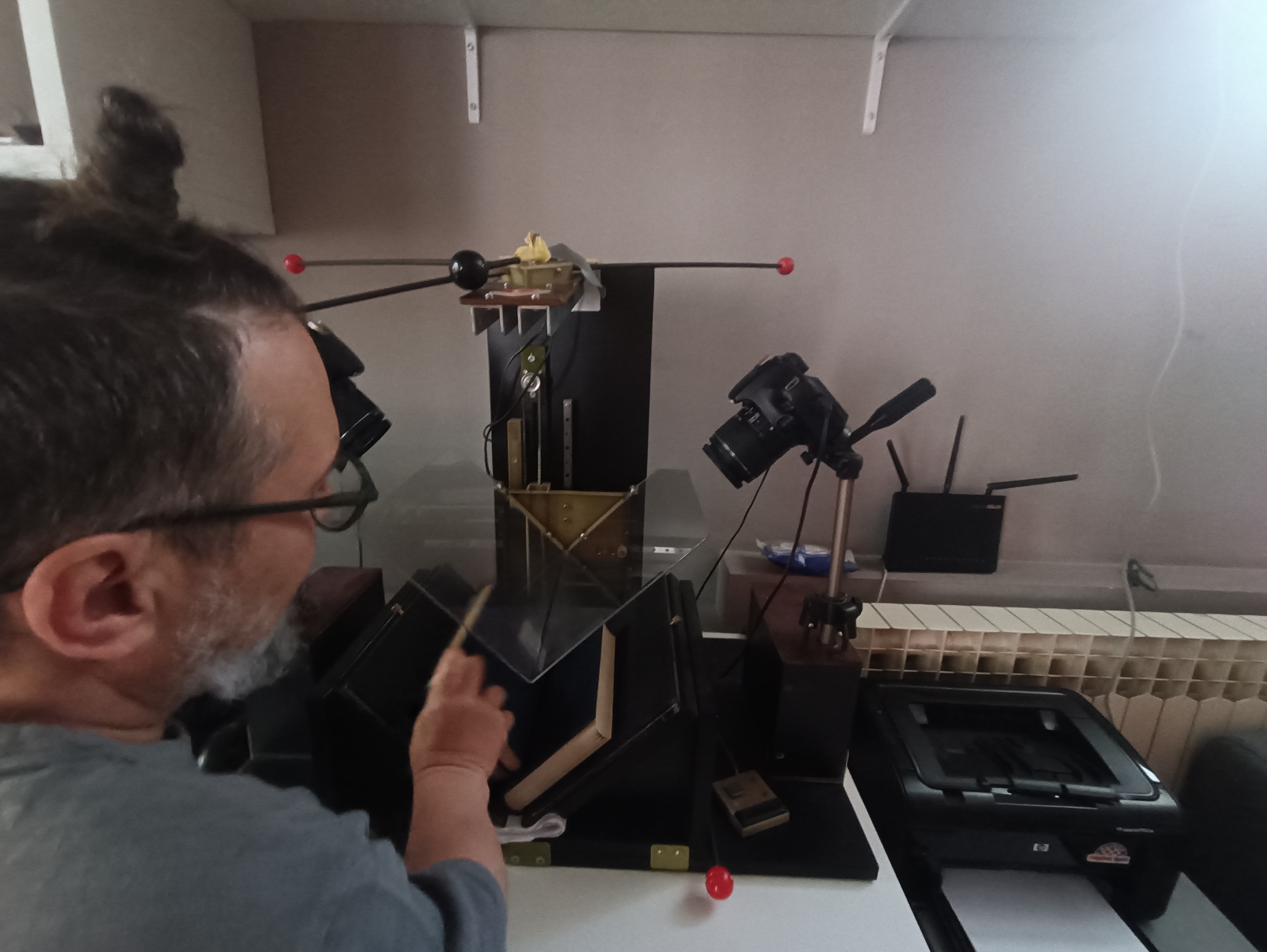
Club Mama. Démo du scanner de livres DIY par Tomislav.
Club Mama. DIY bookscanner's demo by Tomislav. -
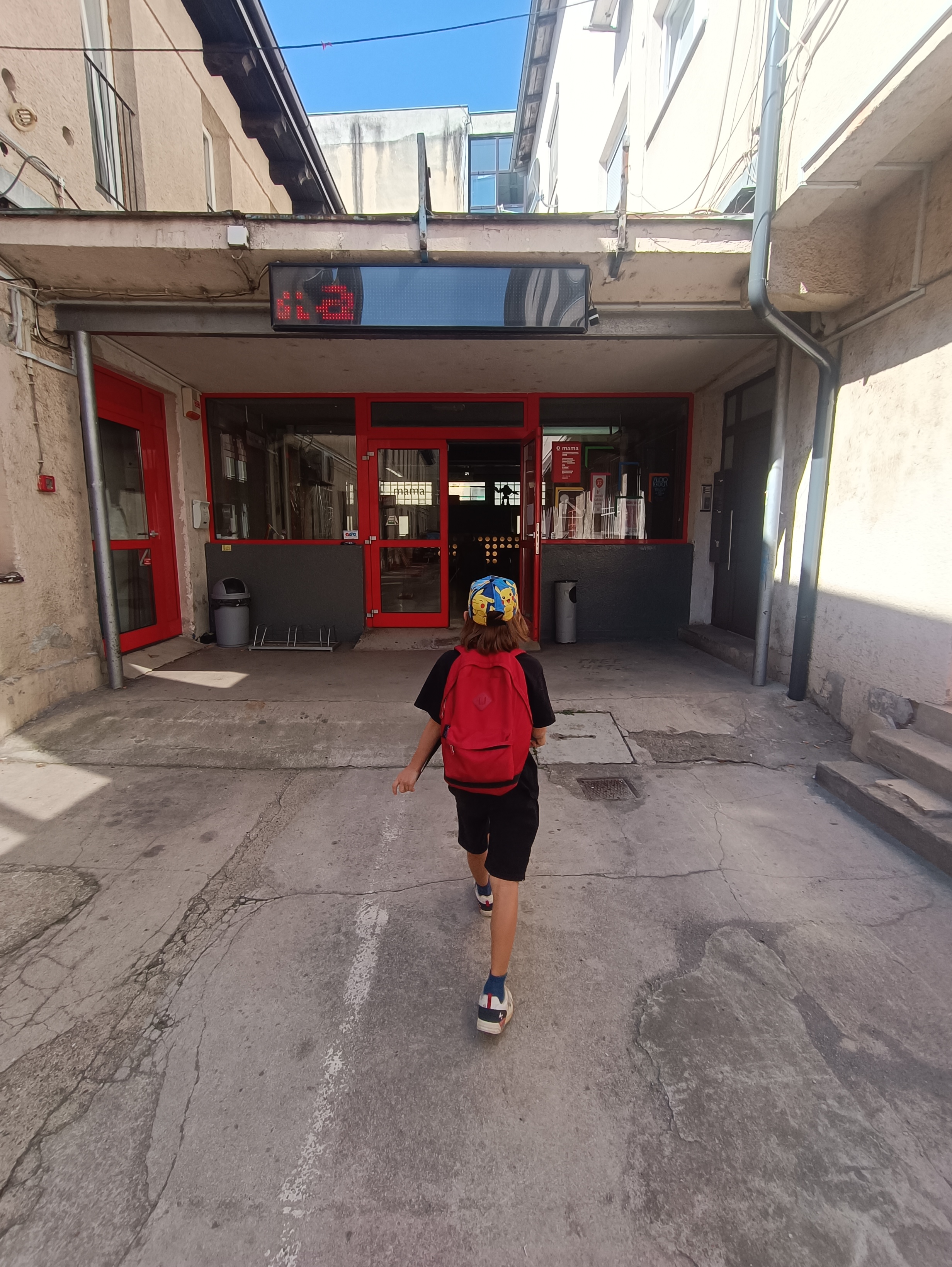
Le club MaMa, hacklab dans le centre-ville de Zagreb.
The MaMa club, a hacklab in downtown Zagreb.
In search of frugal web and companion stories
Travel-to-print to Croatia
Through its mobility grants, the Rewilding Cultures programme encourages new ways of imagining travel and cultural exchange in Europe. Catherine Lenoble, laureate of the 2025 mobility conversation, reflects on her experience here.
Catherine Lenoble is a text worker, hybrid artist and commons activist based in Tours. Alongside her cultural activism within creative communities (hacklabs, fablabs, medialabs, publishing, cyberfeminism), she is developing a research-creation space that questions how we read, write and edit in a digital environment. Since 2010, she has been creating editorial and/or fictional objects, web and/or print, in situ and/or online, in the form of publications, installations, performances and workshops. In 2022, she co-founded the PrintLab with artist Dieudonné Cartier, a workshop dedicated to riso printing and micro-publishing within a fablab in Tours to explore other ways of thinking about publishing.
For the love of print, short supply chains and marginal narratives.
She went to Croatia to meet the initiators of Pirate Care (Valeria Graziano, Marcell Mars, Tomislav Medak and Davor Mišković) a transnational research project and network of activists, academics and practitioners who oppose the criminalisation of solidarity and advocate for a common care infrastructure.
Valeria Graziano (cultural theorist, activist, researcher) participates in research initiatives in the cultural sector and social movements, focused on popular pedagogy and the politics of leisure, repair practices and the rejection of unpaid work, care and hacking.
Marcell Mars (activist, independent researcher, artist) is behind projects that have contributed to the development of commons in Croatia and beyond, such as Public Library and Memory of the world, socio-technical infrastructures created to facilitate universal access to knowledge.
Tomislav Medak is a founding member of the theoretical and editorial team of the Multimedia Institute/MAMA in Zagreb where he has been organizing conferences, colloquia and exhibitions since 2000, and publishing works on political economy, tactical media and the commons.
Davor Mišković is the director of Drugo more, a non-profit organization based in Rijeka that produces, promotes, researches, and disseminates culture of general interest with and for communities. Its programming lies at the intersections of arts, sciences, and society.
What if… ?
What if we could take a step (or steps) back in terms of cultural and artistic mobility, what would we “allow ourselves” to do?
It didn’t actually take me long to come up with a proposal, encouraged by the original format of the Rewilding Cultures grant.
Travel by train.
Take my time.
To travel with a Web-to-print publishing tool.
To visit artist-researchers in Croatia who share similar interests in these practices (publishing tools, open knowledge, technical infrastructure maintenance).
And to experience this adventure with my son.
That’s how we set off for 12 days in August with Yuri, aged 8, heading for Croatia.
Publish too
I had been wanting to experiment more with projects combining micro-publishing and Web-to-print technologies for some time, in order to continue developing interesting editorial productions. Web-to-print combines: ‘the use of web technologies (HTML, CSS and JS) to produce a print-ready PDF file from a browser, the use of free and open source tools for graphic design, and the use of programming and scripts for layout’.
These practices are quietly revolutionising a system dominated by publishing chains that are still very vertical, commercial and proprietary. They are the work of a community of artists, designers and collectives that are very active in Belgium, the Netherlands and France. They are part of a continuum of thinking that stems from ‘permacomputing’, a movement at the crossroads of digital arts, hacking and web design that advocates more sober tools and resource-friendly practices. ‘Permapublishing’ is its application in the field of publishing and graphic design.
Sarah Garcin is one of these curious minds, an artist-designer and member of the Atelier des chercheurs and the collective Prepostprint, which explores alternative paths to publication (and a whole host of other convivial practices ranging from cooking to radio and, more recently, technocritical songwriting!).
‘Hello Sarah?’ We had already worked together in the past, and we were picking up where we left off with our projects, so I shared with her my desire/idea to use a publishing tool (to be able to edit and narrate ‘all-terrain’ content, in situ or on the train). A month later, we met up at La Générale in Paris in July for a working session, ready to test a ‘companion tool’ for the upcoming trip.
The railway adventurers
The journey began on the Paris-Nice night train, that legendary night train line that runs along the Mediterranean coast at dawn. It took us an extra day to cross northern Italy and reach Venice in the evening. Arriving by train in Venice, between land and sea, is always magical. We stayed there for three nights on the island of Giudecca.
There’s something different about travelling with a child.
What happens at eye level.
What is looked at, questioned, desired.
What is listened to and tasted.
What is created.
The journey from Venice to Rijeka will hold a few surprises for us. There are no longer any trains crossing the border from Italy to Slovenia, so we will take a bus from Trieste to Sežana, then a train to Pivka, a rural hub where we will wait for the last train connection to Rijeka.
An industrial port city on the Adriatic coast, Rijeka remained under Habsburg rule for a long time before being occupied by the Italian army, becoming a short-lived Free State of Fiume, and then being annexed by Italy. It was recaptured by Tito’s troops and annexed to Yugoslavia after the Second World War before proclaiming its independence in 1991. Its heritage is a cultural mille-feuille. It will become European Capital of Culture in 2020.
Conversations
We are staying in Croatia for a week, mainly in Rijeka and then Zagreb. Our days are organised flexibly according to the availability of Davor, Valeria, Marcell and Tomislav, the team at Pirate Care. With each of them, we engage in conversation about our shared activities and the activist knowledge that comes with them (in laboratory spaces, with open technical tools and infrastructure, allied networks in Europe, editorial practices and collective publications).
First meeting at the premises of Drugo More, hosted by Davor and Barbora. Yuri settles in with his second Harry Potter book while we also journey through past, present and future times. Founded in 1999, Drugo More has a quarter of a century of cultural activism, tactical media and hybrid arts under its belt, through its mediation activities, civic actions, festivals, exhibitions and workshops.
Around the table, coffee, publications and fanzines printed in riso. The MCD special edition L’Europe des medialabs is our relic (I was the editorial coordinator… in 2011 and Drugo More contributed to it), a shared archive that we leaf through. Despite multiple crises, some of these labs and collectives are still standing. They are still holding on, often through artistic collaborations and the support of European programmes.
It was in fact as part of the European project “Figure it Out – The art of living through the cracks in the system‘ that we all met or reunited in June 2024 during the Re/Dé}connecte festival co-organised with Labomedia in Orléans. Finally, in August 2025, we reopen the conversations that began a year earlier. In the meantime, the Figure It Out and Pirate Care projects that everyone was working on have been completed and have resulted in publications.
With Valeria and Marcell, discussions take place on café terraces, at their home, during group meals or at the beach, with the children (Yuri and Maté, Valeria and Marcell’s sons) joining us. We exchange books, open our computers to show each other tools, and share our experiences of developing databases and other content libraries, which have involved a lot of hard work, mistakes and, of course, small moments of joy. We also discuss these shared communities of practice (Constant), other collections (Monoskop) and frugal web initiatives (Low tech magazine) that give us renewed energy and inspiration to maintain our exploratory and committed approaches over the long term.
Valeria and Marcell discuss their research at the intersection of ‘care’ and ‘piracy’ and the work they have done on the website syllabus.pirate.care. In the form of a syllabus (course materials), this simple, static website introduces practices of self-organisation and the sharing of tools, technologies and knowledge, offering unconditional solidarity to the most exploited and discriminated against. This content (both theoretical and practical), which is intended to be activated, adapted and enriched, is backed by another tool developed by Marcell and Tomislav, Memoryoftheworld, a network of interconnected libraries that provides access to a huge collection of books in digital format.
We leave Rijeka and head for Zagreb. There we are welcomed by Tomislav, a founding member of the Multimedia Institute / MaMa club, a place that facilitates encounters between hackers, artists, philosophers, DJs and activists, created in 2000. It is here that Tomislav and Marcell launched the GNU GPL EGOBOO.bits publishing label, as well as numerous events and exhibitions on hacking and digital cultures.
Tomislav discusses the place that books have always occupied in their projects, their circulation, their digitisation and their visible/invisible infrastructure, namely libraries. Together with Marcell, they are campaigning for a new form of public library (the Public Library programme) made up of interconnected private libraries (the Memory of the World project). Their approach is accompanied by book-sharing tools, campaigns to digitise endangered knowledge using a book scanner, and exhibitions such as ‘Paper Struggles’ in 2020.
The public library is thus conceived as a critical narrative tool to stimulate debate on intellectual property rights, inequalities in access to culture, science and research, and the monopoly of digitisation by large platforms.
Travel-to-print
This resonates with other forms of hegemony found elsewhere in the book chain, in editorial and graphic practices, dominated by proprietary publishing software (Adobe). Based on the observation that in France, “Public education leads students to become dependent on these proprietary, closed, expensive tools used by a labour market that would like to do without them… but cannot find anyone trained in alternative tools”, art schools, engineering schools and European universities have come together around a joint research project EPE (Écran Papier Édition) to design innovative, well-thought-out and sustainable editorial software tools, under an open licence, for an alternative and creative approach between screen and paper.
Sarah Garcin is currently working on a state-of-the-art technical review of web-to-print devices in this context.
Because yes, there are some!
Viva technodiversity.
That’s it, we’re wrapping up the trip: from Club Mama, Tomislav drops us off at Zagreb station, heading for Ljubljana, the capital of Slovenia, where we’ll spend a few hours waiting for the night train to Munich, then Paris.
From all these journeys and conversations, this investigation and these initial tests with a web-to-print tool, the idea is to publish a companion-narration in the autumn to extend this article, combining cultural journalism, sensitive knowledge and documentary resources. A web and print object. Screen and paper. To explore other ways of editing, printing and amplifying stories that carry these alternatives.
Publish too
Bring forth companion-narratives
PUBLISH TOO is a research and artistic cooperation project with the intention of exploring new forms of creation, publishing and dissemination of “companion stories”.
This could be translated as…
The choice to work, create, and collaborate with appropriate tools to break free from the complex and hierarchical chains of dependency inherent in book production ;
A reflection on the concept of companion-tool to question the role of tools in the emergence of narratives (and vice versa) and to support diverse storytelling and natural histories ;
The experimentation of Web-to-print tools with different audiences and in different contexts to produce and promote narratives that embody alternatives and diversity ;
A focus on the circulation, activation, amplification, and collection of these narratives, as well as on ways of thinking and doing derived from frugal, free, and open-source digital cultures.
PUBLISH TOO is situated within different cultural « environments »:
« Frugal Digital Cultures »: Reflection, design, and use of more sustainable digital services or those incorporating moderation into daily practices.
« Graphic and Editorial Design »: Between paper and screen, storytelling and graphic production, editorial design allows to experiment with the modalities and materialities of reading and writing.
PUBLISH TOO is a winner of the CR! call for projects – co-produced as part of Bourges European Capital of Culture 2028. Led by Catherine Lenoble, withe complicity of Sarah Garcin and Dieudonné Cartier, it is being activated on multiple scales with a myriad of contributors: in Tours, Bourges, the Centre region, within the network of European Capitals of Culture, and online.
Colophon
Web2printLab
Compost (Fr)
Cette édition zéro est issue de la fermentation et de la transformation de divers matériaux, de rencontres, de savoirs ouverts et d’étapes de travail depuis l’été 2025. Elle composte ainsi des expérimentations menées avec le soutien de :
Rewilding Cultures, cofinancé par le programme Europe Créative de l’Union européenne.
Makery, structure ayant assuré le mentorat de la bourse et media en ligne hébergeant les articles des lauréats Rewilding Cultures.
La Fabrique d’Usages Numériques - Funlab, lieu d’accueil de la résidence ÉDITER AUSSI et atelier de pratiques laboratoires dans le champ de la médiation & des cultures numériques (Atelier Sav01rs communs).
La région Centre Val de Loire, à travers son soutien aux actions de médiation numérique développées au Funlab (Atelier Sav01rs communs).
Bourges Capitale Européenne de la Culture 2028, ÉDITER AUSSI est lauréat de l’appel à projet du CR ! - coproduit dans le cadre de Bourges 2028.
Merciii à Ewen, Sarah, Marcell, Valeria, Davor, Tomislav, Dieudonné, Yuri et aux lézards qui font changer la trajectoire des regards.
Outils et process
Cette publication a été réalisée à l’aide d’un outil-compagnon mijoté en Web-to-print avec le CMS Kirby et paged.js par Sarah. Il a été testé par Catherine en situation : dans le train, dans des labs complices, chez l’habitant.e, à la maison et online. La finalisation de cette édition a été facilitées à six mains, avec la complicité de Dieudonné, lors d’une résidence ÉDITER AUSSI accueillie au Funlab à Tours du 3 au 5 mars 2026.
Conception et développement outil-compagnon
Sarah Garcin
Création récit-compagnon et design éditorial
Catherine Lenoble
Conception éditoriale et impression
Dieudonné Cartier
Typographies
Compagnon (Velvetyne) et Adelphe (Bye Bye Binary)
Licence
L’ensemble de l’édition est mis à disposition selon la licence CC4r (Conditions Collectives de réutilisation) : https://constantvzw.org/wefts/cc4r.fr.html
Imprimé à 150 ex. en mars 2026 au Fun·Print·Lab à Tours.
Éditions Productions Intérieures Brutes - Collection Éditer aussi
ISBN : 9 - 782959 - 258350
Compost (En)
This pilot edition stems from the fermentation and transformation of various materials, encounters, open knowledge, and work stages since the summer of 2025.
It thus composts experiments conducted with the support of :
Rewilding Cultures, co-financed by the European Union’s Creative Europe program.
Makery, the organization that provided mentorship for the grant and the online media platform hosting the articles of the Rewilding Cultures laureates.
La Fabrique d’Usages Numériques - Funlab, host of the ÉDITER AUSSI residency and a workshop for practical laboratory work in the field of mediation & digital cultures (Atelier Sav01rs communs).
La région Centre Val de Loire, through its support of digital mediation initiatives developed at Funlab (Atelier Sav01rs communs).
Bourges Capitale Européenne de la Culture 2028, ÉDITER AUSSI is a laureate of the CRI’s call for projects - co-produced as part of Bourges 2028.
Thank you to Ewen, Sarah, Marcell, Valeria, Davor, Tomislav, Dieudonné, Yuri and the lizards that change the trajectory of gazes.
Tools and Processes
This publication was created using web-to-print technology with the Kirby CMS and paged.js. On trains, in collaborative labs, at people’s homes, at home, and online. Six people worked together to create and finalize this edition. The creation and finalization of this edition were facilitated by a collaborative effort.
This publication was created using a companion-tool developeled by Sarah for web-to-print with Kirby CMS and paged.js. It was tested by Catherine in various settings : on the train, in partner labs, in people’s homes, at home, and online. The finalization of this edition were facilitated collaboratively, with the support of Dieudonné, during a residency PUBLISH TOO hosted at Funlab in Tours from March 3rd to 5th, 2026.
Companion-tool design and development
Sarah Garcin
Companion-story creation and editorial design
Catherine Lenoble
Editorial conception and printing
Dieudonné Cartier
Fonts
Compagnon (Velvetyne) and Adelphe (Bye Bye Binary)
License
This entire work is licensed under CC4r (Collective Agreement for Reuse) : https://constantvzw.org/wefts/cc4r.fr.html
Printed in March 2026 at the Fun·Print·Lab, Tours, 150 copies.
Éditions Productions Intérieures Brutes - Collection Éditer aussi
ISBN : 9 - 782959 - 258350